
Mobility Scooter Battery Amp Hour Guide: Choosing the Right Capacity (2026)
Buying the physically largest battery you can find won't necessarily guarantee a longer journey if the capacity isn't correctly matched to your equipment's power draw. If you've ever faced the anxiety of a scooter slowing down mid-journey or felt baffled by the technical jump from 7Ah to 9Ah, you're certainly not alone. This mobility scooter battery amp hour guide breaks down the essential data you need to ensure your mobility scooter has the range and reliability required for daily independence. Mastering these specifications is the only way to avoid the frustration of a battery that simply doesn't fit or perform as expected.
You likely agree that nothing is more important than knowing your scooter will get you home safely without a loss in performance. We'll help you understand how to select a battery that provides sufficient range whilst fitting perfectly into your scooter's battery tray. This article explores the technical differences between standard and uprated Lucas AGM batteries, giving you the facts to choose the right capacity for your lifestyle. You'll gain the technical confidence to identify the ideal power solution and find a dependable UK supplier for your next replacement.
Key Takeaways
- Understand that Amp Hours (Ah) represent the total energy capacity of your battery, functioning as a technical "fuel tank" that determines your available range.
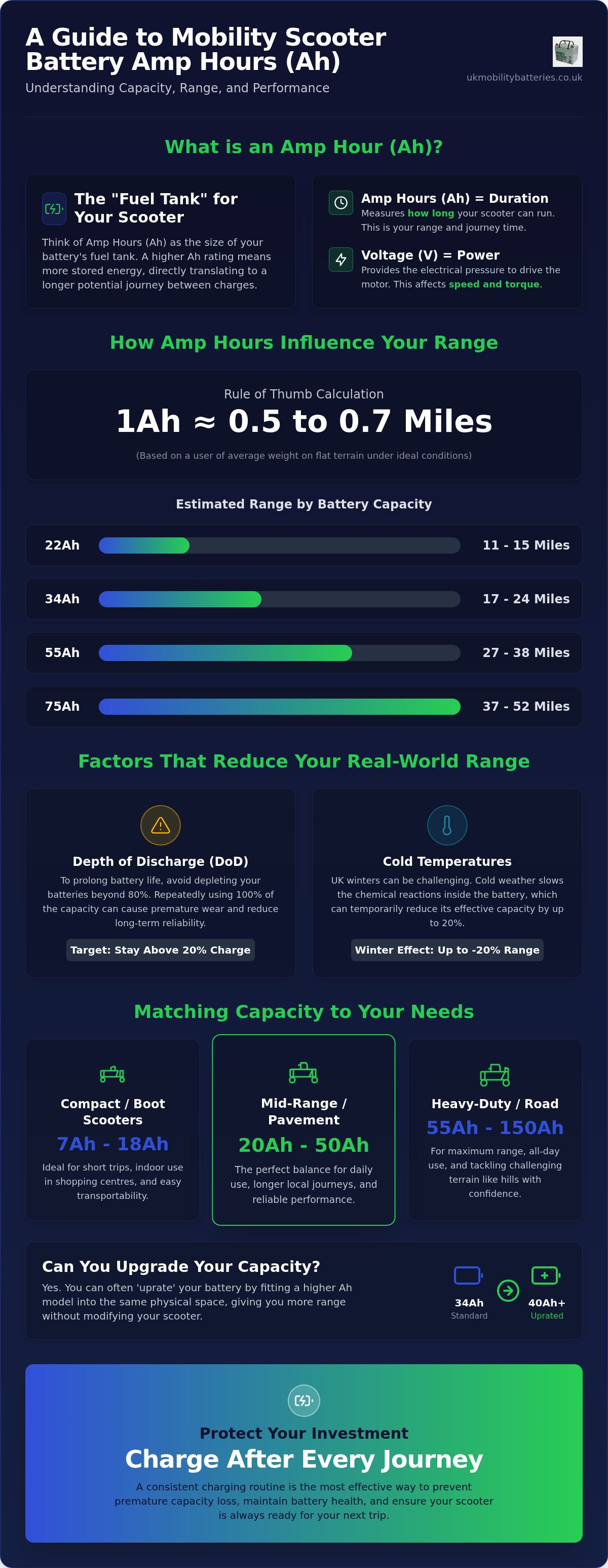
- Use this mobility scooter battery amp hour guide to calculate potential distance, based on a baseline of 0.5 to 0.7 miles of travel for every 1Ah of capacity.
- Identify the correct power tier for your specific equipment, ranging from standard 7Ah units for compact boot scooters to heavy-duty 150Ah deep-cycle batteries.
- Learn how to uprate your scooter's performance by fitting higher-density batteries that provide increased capacity within the same physical dimensions.
- Protect your investment by implementing a consistent charging routine after every journey to prevent premature capacity fade and maintain long-term reliability.
What are Amp Hours (Ah) and Why Do They Matter for Your Scooter?
An Amp Hour (Ah) is a unit of electric charge used to measure the total capacity of a battery. It represents the specific amount of current a battery can deliver consistently over a one-hour period before the voltage drops below a functional level. In this mobility scooter battery amp hour guide, we treat the Ah rating as the primary indicator of your scooter's potential range. Without a clear understanding of this metric, you risk purchasing a battery that cannot meet your daily travel requirements.
Think of the Ah rating as the size of a fuel tank. A vehicle with a 100-litre tank holds more fuel than one with a 50-litre tank, allowing it to travel a greater distance before refuelling. Similarly, a battery with a higher Ah rating stores more energy, which translates to longer journeys between charges. For UK users who rely on their scooters for essential shopping trips or social visits, choosing the correct capacity is the most effective way to eliminate range anxiety.
It is vital to distinguish between capacity and voltage. Whilst most mobility scooters operate on a 24V system, this is almost always achieved by connecting two 12V batteries in series. The voltage provides the electrical pressure required to drive the motor, whereas the Ah rating determines how long that power remains available. Increasing the Ah rating does not change the voltage; it simply extends the duration of your trip.
The Difference Between Capacity and Power
Ah measures "how long" your scooter will run, not "how fast" it will go. Speed and torque are governed by the motor and controller specifications rather than the battery's storage capacity. Many users confuse Ah with Cold Cranking Amps (CCA), a rating typically found on car batteries. Car batteries provide a massive, short burst of energy to start an engine. Conversely, mobility scooters require deep-cycle AGM batteries. These units are engineered for a steady, continuous discharge over several hours, making them far more durable for the constant stop-start nature of pavement travel.
How to Locate the Ah Rating on Your Current Battery
Most reputable batteries feature a clear label on the casing, such as "12V 34Ah" or "12V 75Ah". To understand What is an Amp Hour in a practical context, you should look for the "C20" discharge rate reference often printed on the label. This standard indicates that the battery's capacity was measured over a 20-hour discharge period, which is the industry benchmark for deep-cycle mobility applications. For a reliable mobility scooter battery amp hour guide, always prioritise this nominal Ah rating. Avoid labels that only highlight "peak" or "starting" amps, as these figures are irrelevant for mobility use and often mask the true, lower capacity of the battery.
How Amp Hours Influence Range: Calculating Your Potential Distance
Predicting exactly how far your scooter will travel requires more than just looking at the number on the side of the casing. As a baseline for this mobility scooter battery amp hour guide, you can expect approximately 0.5 to 0.7 miles of range for every 1Ah of capacity under ideal conditions. For example, a pair of 34Ah batteries should theoretically provide between 17 and 24 miles. However, these are laboratory figures. In practice, you must account for the Depth of Discharge (DoD). To maintain the health of your Lucas AGM batteries, you should avoid depleting them beyond 80%. Using 100% of the available amp hours repeatedly will lead to premature capacity loss and reduced service life.
External temperatures also play a significant role. UK winters present a specific challenge for lead-acid chemistry. Chemical reactions within the battery slow down as temperatures drop. In sub-zero conditions, your effective capacity can decrease by up to 20%. This means a journey that is easy in July might become risky in January. You should always factor in this seasonal "capacity tax" when planning longer trips during the winter months.
The Ah to Range Estimation Table
The following estimates assume a standard 24V system (two batteries connected in series) and a user of average weight on flat terrain. Using leak proof mobility batteries ensures that internal efficiency remains high, as these sealed units are designed to prevent electrolyte loss and maintain consistent discharge rates:
- 12Ah: 6 to 8 miles. Ideal for short trips to local shops.
- 34Ah: 15 to 20 miles. Suitable for mid-range pavement scooters.
- 75Ah: 25 to 30 miles. Designed for heavy-duty, road-legal Class 3 scooters.
Environmental and External Factors
The quality of UK pavements significantly affects energy consumption. Climbing kerbs or navigating uneven surfaces requires a higher current draw, depleting amp hours faster than cruising on smooth tarmac. Stop-start behaviour in busy town centres is equally demanding. Every time you accelerate from a standstill, the motor pulls a peak current that taxes the battery. Even tyre pressure plays a role; under-inflated tyres increase rolling resistance, forcing the battery to work harder to maintain speed. If you are unsure which capacity fits your specific terrain, our team can provide expert technical guidance on selecting the right Lucas battery for your needs.
Mobility Scooter Battery Capacity Tiers: From 7Ah to 150Ah
Selecting the correct tier is as much about physical dimensions as it is about electrical capacity. This mobility scooter battery amp hour guide organises batteries into three distinct categories based on their application: Small (7Ah to 22Ah), Medium (30Ah to 55Ah), and Large (60Ah to 150Ah). Matching these tiers to your specific vehicle class ensures you do not over-invest in capacity that won't fit your battery tray or under-invest and end up stranded. Each tier serves a specific user profile, from the occasional shopper to the long-distance road user.
Boot Scooters and Portable Devices (7Ah - 22Ah)
The 12V 7Ah battery for mobility scooter is the industry standard for lightweight, transportable models. These batteries prioritise portability; they are designed for easy lifting and often sit in a detachable battery pack for indoor charging. For users seeking a slight range extension without increasing physical size, the Lucas 12V 9Ah Uprated Sealed AGM Battery is a functional favourite. It occupies the same footprint as the 7Ah model but contains a higher lead density, providing approximately 28% more capacity for the same dimensions. We also supply Lucas 12V 12Ah and 20Ah models for mid-range travel scooters that require a bit more stamina for day trips. Because these batteries are smaller, they reach their depth-of-discharge limit sooner and require more frequent charging cycles than their larger counterparts.
Mid-Range and Heavy-Duty Solutions (34Ah - 150Ah)
Mid-sized pavement scooters typically rely on the Lucas 12V 34Ah Sealed AGM Deep Cycle Battery. This capacity is the standard for 4mph scooters, providing the necessary energy for daily town centre use. For users requiring all-day independence or those navigating hilly terrain, the Lucas 12V 50Ah and 55Ah options are superior choices. These batteries are significantly heavier; a 50Ah battery can weigh nearly double that of a 20Ah unit, so they are only found in non-portable chassis.
Capacities exceeding 75Ah are reserved for Class 3 road-legal scooters. These 8mph vehicles need substantial amp hours to maintain road speeds and climb gradients safely. For specialised off-road equipment or high-mileage users, the range extends up to 150Ah. These large-scale batteries ensure that even the most demanding power chairs and scooters remain operational over long distances in varied UK weather conditions. Choosing the right tier ensures your scooter remains a reliable tool for independence rather than a source of technical frustration.
Upgrading Your Capacity: Can You Fit a Higher Ah Battery?
You can often increase your scooter's range by installing a battery with a higher Ah rating than the original equipment. This is achievable through the use of "uprated" batteries. These specialised units share the exact same external casing dimensions as standard models but feature a higher internal lead density to store more energy. When following a mobility scooter battery amp hour guide, you must balance the desire for extended range with the physical reality of your equipment. A higher capacity battery is almost always heavier because lead is the primary component for energy storage. For instance, moving from a 34Ah to a 50Ah battery adds several kilograms to the total weight, which may affect how you handle individual battery packs during transport.
Before committing to an upgrade, it is vital to understand the lead acid vs agm mobility batteries distinction. Whilst older gel or wet-cell batteries were once common, modern AGM (Absorbent Glass Mat) technology is the industry standard for capacity upgrades. AGM batteries are spill-proof and maintenance-free, making them the safest choice for the higher energy densities found in uprated Lucas models. They provide the steady discharge required for deep-cycle applications without the risks associated with traditional lead-acid designs.
The Three Pillars of an Upgrade
A successful capacity upgrade relies on three technical checks. First, measure the physical length, width, and height of your current battery. Even a few millimetres of difference can prevent the battery lid from closing securely or stop the battery from seating correctly. Second, identify your terminal type. Most small batteries use spade connectors, whilst larger ones use bolt-through terminals. Your existing wiring loom must match these terminals exactly to ensure a secure, spark-free connection. Third, verify your charger's output. If you upgrade to a 75Ah battery but continue using a small 2Ah charger, the charging cycle will be significantly longer. This can lead to a state of permanent undercharge, which causes sulfation and shortens the battery's lifespan.
Common Upgrade Paths
The most frequent upgrade involves replacing a standard Lucas 12V 7Ah battery with a Lucas 12V 9Ah Uprated Sealed AGM Battery. This provides a 28% increase in capacity without requiring any modifications to the scooter's battery tray. Another popular path is moving from 42Ah to 50Ah. This allows for longer daily excursions whilst staying within the same battery box footprint. If a desired battery is physically larger than your current one, never attempt to modify the battery box or chassis yourself. Consult an authorised technician to ensure the vehicle remains balanced and safe for road or pavement use. You can view our complete range of Lucas uprated batteries to find a compatible high-capacity solution for your scooter.
Maintaining Your High-Capacity Batteries for Long-Term Reliability
Your investment in high-capacity batteries only yields long-term benefits if you protect the unit's internal chemistry. Over time, all lead-acid units experience "capacity fade," which is the gradual reduction in available amp hours as the battery ages. This mobility scooter battery amp hour guide emphasises that whilst some decline is inevitable, poor maintenance accelerates the process significantly. If you notice your scooter no longer covers the distances it once did, consult our guide on mobility scooter battery troubleshooting to identify signs of premature capacity loss and learn how to rectify them.
Adopting a strict "charge after every trip" policy is the most effective way to prevent sulfation. Sulfation occurs when lead sulphate crystals harden on the battery plates, a process that happens whenever a battery is left in a partially discharged state. This reduces the active surface area, effectively shrinking your "fuel tank" and lowering the usable Ah rating. A smart charger is essential for this task; it monitors the battery's state and delivers the correct voltage stages to ensure a deep, safe replenishment without the risk of overcharging or overheating the cells.
Charging Habits to Protect Your Ah Rating
Leaving your batteries partially charged for days at a time is the quickest way to destroy usable capacity. For the best results, perform a full 8-12 hour charge cycle at least once a week, even if you haven't used the scooter extensively. This ensures the cells remain balanced and fully saturated. These habits are just as critical for other mobility aids; you can read more about electric wheelchair battery life expectancy to see how similar maintenance routines impact deep-cycle AGM performance over several years of use.
Storage Tips for Preserving Capacity
If you plan to store your scooter over the winter, you must organise your storage routine carefully to avoid self-discharge. Always charge the batteries fully before putting the equipment away. Extreme cold or heat increases the self-discharge rate, meaning a battery left in a garage in January will lose its charge faster than one kept at room temperature. Check the charge level every month and top it up if necessary to keep the voltage stable. AGM batteries should never be stored in a discharged state. Following these technical steps ensures that when spring arrives, your high-capacity Lucas batteries are still capable of delivering their full rated amp hours for your daily independence.
Securing Your Daily Range and Independence
Selecting a battery based on technical data rather than guesswork ensures your scooter remains a reliable tool for independence. This mobility scooter battery amp hour guide has provided the framework to calculate your distance and identify when an uprated battery offers a superior solution for your needs. By matching your equipment's power draw with the correct capacity tier, you eliminate the technical uncertainty that leads to range anxiety. Consistent maintenance and correct charging cycles will protect this investment for years to come.
We provide maintenance-free and spill-proof designs that utilise premium Lucas AGM technology to ensure performance in all UK environments. Our specialists offer expert UK-based technical support to help you navigate compatibility and terminal specifications. Browse our full range of Lucas Mobility Batteries with fast UK delivery to secure the power solution your lifestyle requires. You can travel with confidence knowing your scooter is equipped with a battery matched perfectly to your daily requirements.
Frequently Asked Questions
Can I replace 34Ah batteries with 50Ah in my mobility scooter?
You can upgrade to 50Ah batteries if the physical dimensions of your battery tray allow for the larger casing. While the electrical output remains compatible, 50Ah units are significantly heavier and larger than 34Ah models. You must measure your current battery box and verify that the scooter's chassis can handle the additional weight before proceeding with the installation.
What happens if I use a battery with a lower amp hour rating than the original?
Using a lower Ah rating will result in a much shorter travel range between charges. The motor may also draw current at a rate that exceeds the smaller battery's design limits, leading to internal overheating. This mobility scooter battery amp hour guide recommends staying at or above the manufacturer's original specification to avoid premature cell failure and reduced performance.
How many miles will a 12V 20Ah battery last on a single charge?
A pair of 20Ah batteries typically provides a range of 10 to 14 miles under standard conditions. This distance varies based on the total load, tyre pressure, and the steepness of the terrain. In cold UK weather, you should expect the effective range to sit at the lower end of this estimate due to reduced chemical efficiency within the AGM cells.
Does a higher amp hour rating mean the battery is physically larger?
In most cases, a higher Ah rating requires more lead, which increases the battery's physical size and weight. There are exceptions for "uprated" models, such as the Lucas 9Ah battery, which fits the same footprint as a 7Ah unit. These specialised batteries use higher-density internal plates to pack more energy into the same external dimensions for compact boot scooters.
Will a higher Ah battery make my mobility scooter go faster?
A higher Ah rating will not increase your scooter's top speed. Speed is governed by the motor and the 24V controller system, not the storage capacity. Increasing the amp hours is equivalent to fitting a larger fuel tank to a car; it allows you to travel for a longer duration and over greater distances, but the maximum speed remains unchanged.
Can I use my existing charger if I upgrade to a higher amp hour battery?
You can generally use your original charger, but the time required to reach a full charge will increase. If you perform a substantial upgrade, such as moving from 34Ah to 75Ah, your existing 2Ah charger might take over 30 hours to complete a cycle. In such cases, upgrading to a charger with a higher Amp output is necessary to ensure the batteries are fully replenished overnight.
Is it better to have two 12V batteries or one 24V battery for my scooter?
Most mobility scooters are designed to use two 12V batteries connected in series to produce 24V. This configuration is preferred by manufacturers because two separate batteries are easier to lift and position within the chassis. It also provides more flexibility for the layout of the battery compartment compared to a single, heavy 24V unit of the same total capacity.
How do I know if my mobility scooter batteries have lost their capacity?
The primary symptom of capacity loss is a sudden and noticeable reduction in your usual range. If your battery meter drops into the red during a short trip that previously caused no issues, the cells are likely failing. Using a mobility scooter battery amp hour guide to monitor your charging habits can help, but once capacity fade occurs due to age or sulfation, the batteries usually require replacement.