
IATA Wheelchair Battery Rules: UK Air Travel Guide 2026
Can you take your wheelchair battery on a plane? The answer depends on more than the battery alone. IATA regulations for wheelchair batteries distinguish between lithium-ion, non-spillable batteries such as AGM and gel, and spillable wet-cell batteries. Individual airlines may also set additional conditions.
It can be difficult to identify a battery’s type or capacity from its label, yet those details affect whether it stays fitted, needs removing or requires terminal protection. Before contacting the airline, identify the battery chemistry and record its specifications. This makes it easier to get instructions that apply to your equipment.
This guide explains how battery type, capacity and installation affect air travel under the 2026 rules. It also sets out what information to provide when requesting airline approval, and what to ask about removal, packaging and handling. Always confirm the arrangements for your specific flight rather than assuming one airline’s policy applies to every journey.
Key Takeaways
- The IATA regulations for wheelchair batteries provide an industry framework. The carrier’s approval and handling instructions also shape your travel plan.
- Identify the battery chemistry and record its label details, including voltage, amp-hours or watt-hours where shown.
- Check how the rules apply when the battery is fitted or removed. Chemistry and capacity can affect handling requirements.
- Give the airline your wheelchair’s make and model, battery type, quantity and stated capacity, then keep its written instructions.
- Choose a replacement that is compatible with your mobility equipment, and check its travel approval separately.
IATA regulations for wheelchair batteries: what travellers need to know
Planning air travel with a powered wheelchair involves more than checking whether its battery is permitted. Requirements depend on the battery’s chemistry and capacity, whether it stays fitted to the mobility aid, and the operating airline’s approval and loading process. The IATA regulations for wheelchair batteries provide an important framework, but they do not confirm that a particular device will be accepted on every flight.
Airline acceptance depends on the applicable dangerous-goods rules and the carrier’s own process. Check current instructions with the airline operating each flight, including connecting legs. The route, aircraft and handling arrangements may affect what information or steps the carrier requires.
What does IATA guidance cover for mobility aids?
The International Air Transport Association (IATA) publishes Dangerous Goods Regulations (DGR) for the safe transport of dangerous goods by air. The DGR provide airline-industry procedures for handling items such as batteries. They are based on the International Civil Aviation Organization’s (ICAO) technical standards, while each airline applies its own operational process. A general provision does not guarantee acceptance on a specific route or aircraft.
This distinction matters in practice. Even if a battery meets a relevant dangerous-goods provision, the carrier may need advance details, approval or instructions for securing the wheelchair and managing the battery. UK passengers should also distinguish international dangerous-goods guidance from current UK Civil Aviation Authority (CAA) passenger guidance and the operating airline’s instructions. Check the relevant guidance and follow the carrier’s process for your booking.
Why does the wheelchair battery type matter?
Battery categories have different carriage and handling conditions. Lithium-ion, non-spillable lead-acid and spillable wet-cell batteries are not interchangeable classifications. Chemistry can affect capacity limits, whether a battery may remain installed, and what protection or packaging is required if it is removed. A Lithium-ion battery uses different chemistry from a sealed lead-acid AGM battery, so appearance alone is not a reliable way to identify it.
Start with the battery label, then compare it with the wheelchair manual or manufacturer documentation. Record the stated chemistry, capacity and battery quantity. If the label is unclear, do not infer the category from the battery’s shape or sealed construction. An AGM battery’s sealed construction alone does not establish airline acceptance. You still need to check its classification and the carrier’s current instructions.
Keep the battery information with the wheelchair’s make and model. This gives the airline details about your actual equipment, rather than a broad description such as “electric wheelchair”. It also helps clarify whether the battery stays fitted or must be removed, and what to do about terminals, packaging or accidental activation. Include these details in your travel plan instead of making assumptions.
Use the battery’s stated specifications to establish its capacity and category. If information is missing or difficult to interpret, refer to the equipment documentation before contacting the airline. Do not assume a replacement battery will follow the same travel arrangements simply because it fits the device. Confirm its specifications and the carrier’s current procedure.
How battery chemistry, watt-hours and installation affect air travel
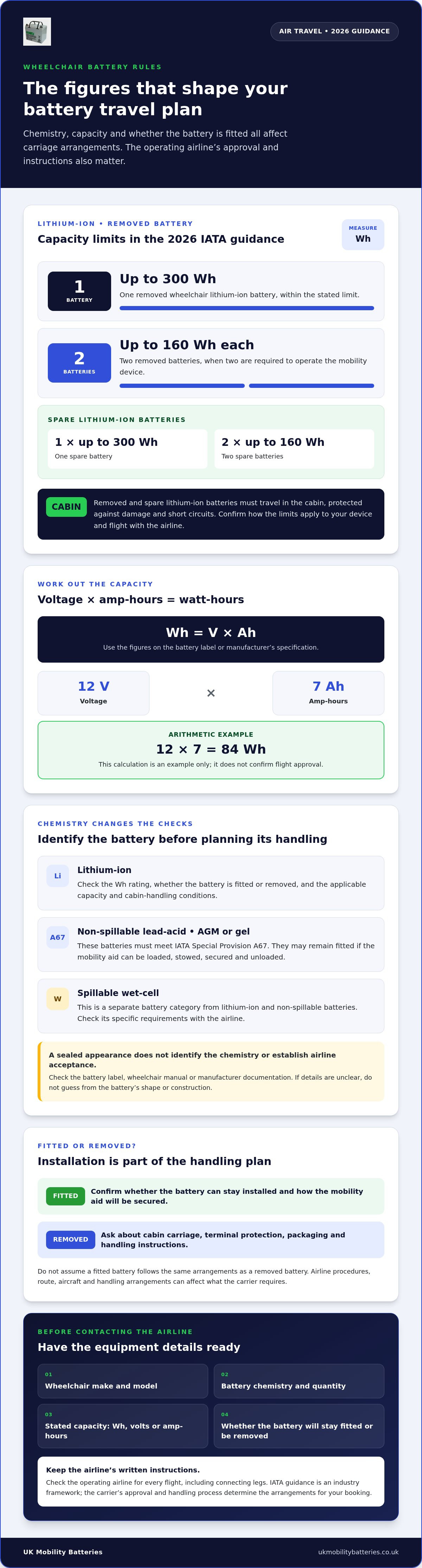
Battery chemistry tells you which carriage conditions to check. Capacity and whether the battery stays fitted can affect the handling plan. The 2026 IATA Dangerous Goods Regulations distinguish lithium-ion batteries from non-spillable and spillable wet-cell batteries. Airline procedures also matter, so use the figures below as a starting point and confirm current requirements for your flight.
Watt-hours (Wh) express a battery’s energy capacity, calculated from voltage and amp-hours; the figure alone does not determine whether an airline will accept it. Check the label or manufacturer’s specification sheet first. If both figures are shown, calculate Wh = V × Ah. For example, a 12 V, 7 Ah battery gives 84 Wh (12 × 7). This is an arithmetic example, not confirmation that a battery is suitable or approved for a particular flight.
Lithium-ion wheelchair batteries and watt-hour ratings
For 2026, the IATA limits supplied for a removed wheelchair lithium-ion battery are one battery up to 300 Wh, or two batteries up to 160 Wh each when two are required to operate the device. Spare lithium-ion batteries are limited to one up to 300 Wh or two up to 160 Wh each. Removed and spare batteries must travel in the cabin, protected against damage and short circuits. Ask the airline how these limits apply to your device and flight.
Look for a Wh rating on the battery label or in the manufacturer’s documentation. If it is not shown, calculate it only when both volts and amp-hours are reliably stated. Round only as needed to report the result clearly, and retain the original label figures. Do not assume a battery staying fitted is treated the same as one removed for carriage. Confirm the arrangement with the airline.
Sealed AGM and other non-spillable batteries
AGM is a sealed lead-acid battery construction, not a type of lithium-ion battery. Under the current guidance, non-spillable wet-cell batteries such as AGM or gel must meet IATA Special Provision A67. They may remain fitted if the mobility aid can be loaded, stowed, secured and unloaded upright. If that cannot be assured, the battery must be removed. The airline should confirm the handling plan for your equipment.
Spillable wet-cell batteries have different precautions: the wheelchair must remain upright during handling, or the battery must be removed and packed under the applicable requirements. Do not apply the rules for AGM or lithium-ion batteries to a spillable battery. Identify the battery from its label or manufacturer documentation, then check the relevant conditions with the carrier.
For battery-selection context, compare your device’s required chemistry, voltage, capacity and dimensions with guidance on mobility batteries. A compatible replacement still needs a separate travel check: battery specifications and airline acceptance are different questions.
IATA rules versus airline policies: what determines acceptance?
A battery meeting a dangerous-goods condition does not automatically mean the wheelchair is cleared to travel. The IATA regulations for wheelchair batteries provide an industry framework for assessing carriage. Acceptance also depends on the operating airline’s approval and handling process. The safety provisions establish requirements, and the carrier applies them to the equipment and journey it will operate.
Who sets the rules for wheelchair batteries on flights?
IATA publishes Dangerous Goods Regulations for the airline industry. The International Civil Aviation Organization (ICAO) establishes international technical standards for air transport of dangerous goods. The UK Civil Aviation Authority (CAA) provides UK passenger information and oversees relevant aviation requirements. Airlines manage their own booking, approval and operational arrangements within the applicable requirements. These roles are distinct: IATA guidance is not, by itself, an airline’s permission to carry a specific mobility aid.
For UK passenger information, consult the CAA’s special assistance guidance, then follow the current instructions of the airline operating your flight. Official guidance helps explain the framework. The carrier provides the practical details of its notification process, forms and equipment-handling instructions. A general summary, including this guide, is not a substitute for those current instructions.
Why can airline requirements differ?
Carriers apply safety requirements to their own aircraft, loading arrangements and handling procedures. They may therefore request specific battery details or require approval through a particular process. One airline’s form or deadline is not necessarily the process used by another, even when both refer to the same underlying dangerous-goods framework.
Check every flight sector. On a connecting or codeshare journey, the airline that sold the ticket may not operate each flight. Identify the operating carrier for each leg and confirm its process covers your battery, its planned transport and any handling instructions. If one airline’s approval covers only its own sector, obtain the required confirmation for the remaining sectors too.
For example, you might receive approval from the first carrier but have a different airline operating the connection. Do not assume the first approval applies to the second flight. Check who operates each leg, whether the wheelchair can be handled as planned, and whether the carrier needs details submitted separately. Keep written responses and completed forms accessible during your journey.
Make sure the airline has assessed your actual equipment configuration, not just a general description such as “powered wheelchair”. Provide the wheelchair make and model, battery chemistry, quantity and stated capacity. Explain whether the battery is fitted or removable. If those details change, such as after a battery replacement, contact the operating carrier again. A previous decision may not cover different equipment.
The practical approach is to use IATA and relevant official guidance to understand the safety framework, then confirm the process with every operating airline. This avoids a common mistake: treating IATA compliance alone as a guarantee of boarding or carriage.
Pre-flight checklist for travelling with a wheelchair battery
Gather the battery details before contacting the airline. Clear information helps the carrier assess your wheelchair and explain its approval and handling process. The IATA regulations for wheelchair batteries distinguish between battery categories, so do not rely on appearance or assume arrangements from a previous journey still apply.
Information to gather before contacting the airline
Check the battery label and the wheelchair or battery manufacturer’s documentation. Record the chemistry and every capacity figure shown, including voltage, amp-hours (Ah) and watt-hours (Wh). Take a clear photograph of the label and keep the original figures in your notes. If a value is not stated, do not estimate it; share the available documentation with the airline.
Also note the wheelchair’s make and model, how many batteries it uses, and whether each battery is fitted, removable or being carried as a spare. These details help the airline assess the actual configuration. For device-fit and replacement guidance, use a mobility wheelchair battery guide alongside your equipment manual. Do not choose a battery on capacity alone.
Preparing the wheelchair and battery for handling
Ask the operating airline what it requires for your battery and journey. Confirm whether the battery should stay fitted or be removed, how the wheelchair must be secured or isolated, and whether terminals need protection. Do not remove, disconnect or pack a battery based on a general checklist if the carrier’s current instructions specify another procedure.
Clarify whether the wheelchair and any removed battery will travel in the cabin or hold, and how the equipment will be handled during loading and unloading. The arrangement depends on battery type and carrier instructions. Keep written approval, submitted specifications and handling directions with your travel documents so you can refer to the agreed plan at the airport.
- Identify the battery. Use its label and manufacturer information to establish the chemistry. Do not infer it from the casing or sealed construction.
- Record the specifications. Note the wheelchair make and model, battery chemistry, quantity, voltage, Ah and stated Wh. Photograph the label and retain relevant documentation.
- Contact each operating airline. Provide the details for every flight sector, including connecting or codeshare flights, and ask what approval and handling steps apply.
- Keep the written instructions. Follow the carrier’s directions for removal, securing, terminal protection and cabin or hold arrangements. Carry the approval and instructions with you.
Recheck the details if the wheelchair or battery changes before departure. A replacement may fit the device but have different specifications, so confirm the travel arrangements separately. Once you know your device requirements, explore mobility battery options that match them. Product compatibility does not establish airline approval.
Plan your journey and choose a suitable replacement battery
Complete your travel preparations with written approval and handling instructions from the airline operating each flight. The IATA regulations for wheelchair batteries provide a framework, but the carrier must assess your equipment and confirm its own process. Keep that decision separate from battery selection: a replacement may suit your wheelchair without automatically being approved for air travel.
When should you replace a wheelchair battery before travelling?
Consider replacing a battery if it is no longer performing reliably, but do not use travel rules to diagnose a battery fault. A mobility battery troubleshooting guide can help you understand common performance concerns. Before choosing a replacement, compare its specifications with the wheelchair manufacturer’s requirements and the battery currently fitted.
Check more than capacity. The replacement must match the equipment’s required voltage, dimensions, connectors and capacity, as well as its specified battery type. A similar-looking battery or one with a familiar amp-hour rating may still be unsuitable if another specification differs. Use the wheelchair manual and battery documentation to establish the requirements before ordering.
What to do before departure
Once you have the wheelchair and battery details, confirm arrangements with every operating carrier, including connecting flights. Ask for its current approval and instructions covering whether the battery stays fitted or is removed, how it must be secured, terminal protection and transport. If you change the battery or wheelchair after submitting the details, revisit the approval because the carrier’s decision relates to the equipment it assessed.
Keep the following information easy to access during your journey:
- The wheelchair make and model, with relevant manufacturer information.
- The battery chemistry, quantity and capacity as stated on its label or specification sheet.
- Written approval and the airline’s current handling instructions for each flight segment.
Check that the written instructions match your actual setup. If the approval describes a fitted battery, do not assume it also covers a different replacement or a spare. If instructions are unclear or your equipment details change, contact the operating carrier for clarification before departure rather than relying on a general rule or arrangements from an earlier journey.
For UK travellers, preparation involves two separate decisions: whether a battery matches the wheelchair’s technical requirements, and whether the airline accepts the proposed travel arrangement. UK Mobility Batteries sells mobility batteries and provides technical support to help you explore replacement options and understand specifications. Establish your device requirements first, then obtain the carrier’s approval for the specific battery you plan to take.
Prepare now for a more straightforward journey
Keep battery information with your travel records instead of having to reconstruct it at the airport. Store the manufacturer’s specifications and the airline’s written response together, and review the carrier’s current instructions for each journey. If you change the wheelchair or battery, obtain guidance based on the updated equipment.
The IATA regulations for wheelchair batteries help frame the technical questions. Your practical next step is to make sure the battery you intend to travel with is the one the airline has assessed. Keep product suitability and flight acceptance separate, and resolve any uncertainty before departure.
If you’re considering a replacement, UK Mobility Batteries is a specialist retailer of mobility-device batteries, with sealed AGM options from trusted brands including Lucas and technical support for battery selection. Explore wheelchair batteries and get specialist technical support to find an option that matches your equipment requirements. Check the specifications and obtain the carrier’s instructions for the specific battery you plan to travel with.
Frequently Asked Questions
Can I take a wheelchair battery on a plane?
Often, but the operating airline needs to assess your wheelchair and battery before you travel. Send the battery’s chemistry and rating, and explain whether it is fitted, removable or a spare. If your itinerary changes, check whether a different carrier operates the new flight and whether its approval process applies. Keep the airline’s written response accessible instead of relying on arrangements from a previous trip.
What is the IATA watt-hour limit for a wheelchair battery?
There is not one limit that applies to every wheelchair battery. The applicable threshold depends on battery chemistry, quantity and whether each battery is fitted or removed. Find the rating on the battery or its manufacturer’s specification sheet. If it shows volts and amp-hours, these can be used to calculate watt-hours. Then check the current IATA Dangerous Goods Regulations and carrier guidance. The term “wheelchair battery” alone is not enough to identify the limit.
Can I fly with an AGM wheelchair battery?
An AGM battery may be carried under applicable conditions, but sealed construction alone does not establish acceptance. AGM is a form of lead-acid battery, not lithium-ion. Handling instructions may depend on whether the wheelchair can be kept upright during loading and stowage. If your manual only says “sealed battery”, check the battery label or manufacturer’s documentation for its precise type before sending details to the airline.
Do I need airline approval to fly with a powered wheelchair?
Contact the operating airline before travel and follow its current mobility-aid process. Provide enough detail for it to assess your specific wheelchair, rather than asking for a general answer about powered chairs. For a codeshare booking, check which airline operates each flight. Keep copies of any requested forms or supporting documents with your booking information so you can refer to the same details throughout the journey.
Can I take a spare wheelchair battery in my hand luggage?
Do not assume a spare battery can go in hand luggage just because the wheelchair is accepted. Its chemistry and capacity affect the applicable carriage conditions, and the airline will specify where it must travel and how its terminals must be protected. Give the carrier the spare’s own label details, even if it is identical to the fitted battery. Keep the instructions for that battery with your travel documents.
What happens if my wheelchair battery has no readable label?
Ask the wheelchair or battery manufacturer for written specifications before requesting the airline’s assessment. The model name or physical size may not reliably establish the battery’s chemistry or capacity, so do not estimate these details. Send the manufacturer’s documentation to the carrier if requested and keep a copy available during travel. If the manufacturer cannot identify the battery, ask the airline what information it needs before making further arrangements.
Can I replace my wheelchair battery with a higher-capacity one before flying?
Only if the replacement meets the wheelchair manufacturer’s requirements and the airline assesses that specific battery for travel. A higher amp-hour rating alone does not prove the battery will fit or operate correctly. Compare voltage, dimensions, connectors, capacity and chemistry with the device specifications, then provide the replacement’s details to the carrier. The IATA regulations for wheelchair batteries address carriage conditions, not whether a particular battery is compatible with your wheelchair.