
How Tyre Pressure Affects Electric Car Battery Range
Could a few PSI be making your electric car use more energy than it needs to? The impact of tyre pressure on battery range is easy to overlook: under-inflated tyres increase rolling resistance, so the motor has to work harder and the battery may drain faster. That can affect real-world efficiency and the range estimate shown on the dashboard, although the display also responds to driving conditions.
If your range has fallen, checking the tyres is a sensible first step, but pressure isn’t the only possible cause. Cold weather, speed, heating use, journey type and changes in driving conditions can also influence how far an EV travels on a charge. Correcting the pressure may reduce avoidable energy use, but it won’t resolve every range issue.
This guide explains how tyre pressure affects rolling resistance and range, how to find your car’s recommended pressure and check it accurately, and why readings should be taken when the tyres are cold. It also covers the effects of over-inflation and what else to investigate if range remains lower than expected.
Key Takeaways
- The impact of tyre pressure on battery range depends on the vehicle, tyres, pressure difference and driving conditions.
- Under-inflation can increase tyre deformation and rolling resistance. Follow the vehicle maker’s recommended pressure rather than over-inflating to chase extra range.
- Check pressure when tyres are cold, using a reliable gauge and the figures in the handbook or on the vehicle’s pressure placard.
- Weather, speed, load and route can also affect range. Compare similar journeys before deciding whether pressure has made a difference.
- If range remains lower than expected, record energy use and journey conditions to help identify other possible causes.
How tyre pressure affects electric car battery range
Incorrect tyre pressure can increase rolling resistance and energy use. When a tyre is below the vehicle maker’s recommended pressure, it flexes more as it rolls, requiring extra energy to keep the car moving. This can reduce the distance travelled on a charge. The impact of tyre pressure on battery range varies with the vehicle, tyre design, how far pressure differs from the recommendation and the driving conditions.
Pressure is one influence on range, not a complete diagnosis. A change in displayed range or distance per charge may also reflect temperature, speed, road type, vehicle load or heating and air-conditioning use. Correct pressure can remove avoidable resistance, but it cannot guarantee a particular range increase or explain every drop in efficiency.
What does rolling resistance mean for an electric car?
Rolling resistance is the energy a tyre uses as it deforms under the car’s weight and moves against the road surface. Some energy is dissipated as heat during this repeated flexing. If pressure is too low, the tyre can deform more, increasing the resistance the motor must overcome and the demand on the traction battery.
A useful comparison is pushing a loaded trolley with a wheel that squashes more against the floor: it takes greater effort to keep it rolling. Tyres are only one part of a car’s energy use, though. The motor and drivetrain, air resistance and cabin systems also draw energy.
Why pressure matters more than a dashboard range estimate
The dashboard’s remaining-range figure estimates how far the car may travel with its available charge. It can adjust in response to recent energy use and operating conditions, so it may change even when tyre pressure has not. Distance travelled per charge, considered alongside energy consumption over comparable journeys, gives a more useful basis for judging real-world efficiency.
A pressure warning system is useful, but it does not show the full effect of a small pressure difference on energy use. The Tire Pressure Monitoring Systems (TPMS) overview explains how these systems monitor tyre pressure. A warning light should prompt a check, but its absence doesn’t prove that each tyre is at the recommended pressure.
The same pressure reading can also have different practical consequences in different situations. A small deviation may be less noticeable on a steady, level journey than during frequent acceleration, on hilly roads or with a heavier load. Tyre construction and size matter too, so a pressure figure from another EV, even one of a similar size, isn’t a reliable substitute for vehicle-specific guidance.
For a useful assessment, note the pressure in each tyre and compare energy use across similar journeys, with similar speeds, routes, weather and loads. This helps show whether pressure may be contributing without treating a fluctuating range estimate as proof. The following checks can help establish whether tyre pressure is within the manufacturer’s specification.
What under-inflated and over-inflated tyres can change
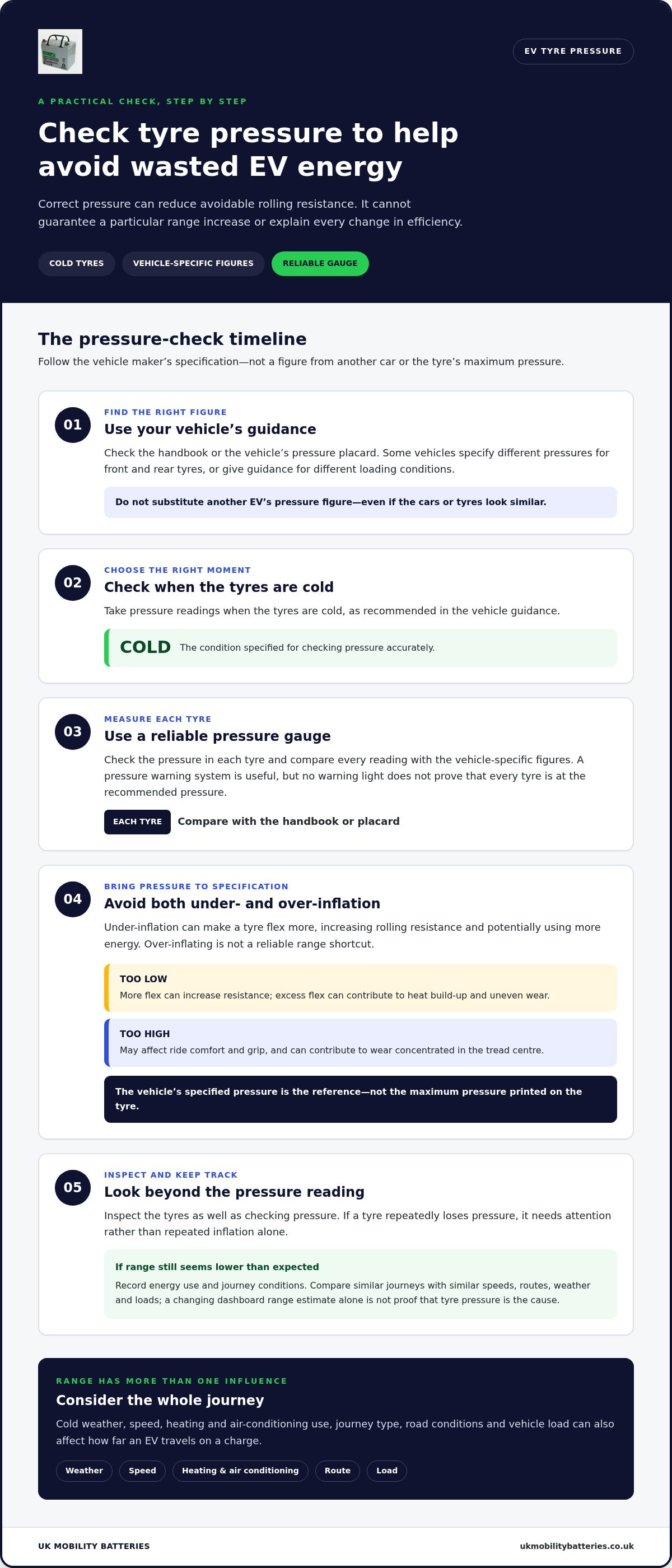
Tyres need to be inflated to the pressure specified for the vehicle and its tyres. Too little pressure can make a tyre flex more as it rolls, increasing rolling resistance and potentially using more energy. Too much pressure isn’t a reliable way to extend range: it can affect ride comfort, grip and wear. The impact of tyre pressure on battery range depends partly on the size of the pressure difference, so don’t assume one adjustment will produce the same result on every electric car.
How under-inflation can increase energy use
A tyre below its recommended pressure tends to deform more under the car’s weight. Its contact area with the road may also change, and extra flexing can increase resistance as the wheel turns. The lower the pressure is relative to the vehicle’s specified figure, the more relevant this effect may become, although its size depends on the tyre, car and driving conditions.
There are other reasons to correct under-inflation, even if a range change isn’t obvious straight away. Excess flex can contribute to heat build-up and uneven wear, particularly towards the tyre shoulders. It may also affect how the car responds on the road. Pressure readings alone won’t reveal every cause of damage or wear, so inspect the tyres as well.
Why over-inflating is not a range shortcut
Adding pressure above the vehicle’s recommendation isn’t a sound efficiency tactic. A more highly inflated tyre may feel firmer over road imperfections, and excess pressure can reduce grip or contribute to wear concentrated in the tread centre. The degree of any effect depends on the tyre and how far its pressure differs from the specified value.
The vehicle’s specified pressure, not the maximum pressure printed on the tyre, is the reference. Check the handbook or pressure placard for the correct figures. Some vehicles specify different pressures for front and rear tyres or give guidance for different loading conditions, so don’t assume a single figure applies to every wheel or journey. Don’t copy the pressure from another car, even if the tyres look similar.
Efficiency is only one consideration. Tyres are part of the vehicle’s contact with the road, so prioritise the maker’s recommended setting rather than trading comfort, grip or even wear for a hoped-for range improvement. If you find a tyre below the specified pressure, bring it back to the correct figure and monitor it. A tyre that repeatedly loses pressure needs attention, rather than repeated inflation alone.
Electric-car traction batteries are different from the batteries used in mobility scooters and wheelchairs. UK Mobility Batteries supplies sealed AGM batteries for mobility equipment. If you need a mobility equipment battery, browse the range separately from your electric-car tyre-pressure checks.
Tyre pressure versus other causes of electric-car range changes
A drop in electric-car range doesn’t automatically point to tyre pressure. Several conditions can increase energy use at the same time, so a single journey rarely shows which factor had the greatest effect. The impact of tyre pressure on battery range is easier to judge when you compare pressure readings and energy consumption with other journey details, rather than relying on the dashboard estimate alone.
| Factor | How it may affect range or energy use |
|---|---|
| Tyre pressure | Pressure below the vehicle’s specification can increase tyre flex and rolling resistance. |
| Weather | Cold conditions can lower tyre pressure and increase the energy needed to warm the cabin or battery. |
| Speed | Sustained higher speeds increase energy demand, including the energy needed to overcome air resistance. |
| Load | Passengers and luggage add weight, which can increase the energy required to move the car. |
| Route | Gradients, stop-start traffic and road surfaces can change the energy used during a journey. |
Which driving conditions can also reduce range?
Temperature affects more than the tyre reading. Cold weather can reduce pressure as well as increase vehicle energy demand, especially if heating is used. A fast motorway journey, a steep route, a full load or repeated acceleration can each raise consumption. These factors often overlap: a cold, hilly trip with several passengers won’t provide a clear measure of pressure’s contribution.
Driving behaviour matters too. Smooth acceleration and anticipating traffic can produce a different consumption pattern from frequent hard acceleration and braking. The dashboard range estimate may respond to recent driving, so it can move up or down after conditions change. That estimate is not the same as measured energy consumption over a completed journey.
How to tell whether pressure is a likely contributor
Start by comparing each tyre’s cold reading with the vehicle-specific value in the handbook or pressure placard. If a tyre is below specification, correct it as directed. Then look for repeatable patterns across comparable journeys, noting energy consumption, weather, route, speed and load. A single trip or changing dashboard estimate can’t isolate cause and effect.
If the readings are correct but consumption remains higher, avoid repeatedly adjusting pressure in search of a range improvement. Review the other conditions in the table and compare like with like, such as similar routes at similar speeds and with similar loads. This won’t prove the exact cause, but it gives a more useful basis for deciding whether pressure is a plausible contributor or whether another change better explains the result.
How to check electric-car tyre pressure correctly
Use the pressure specified for your car, not a figure copied from another vehicle or the maximum pressure printed on a tyre’s sidewall. The correct values are in the vehicle handbook or on the manufacturer’s pressure placard, commonly inside the driver’s door area. They may differ between front and rear tyres or according to the vehicle’s load and configuration.
Where to find the correct pressure specification
Check the handbook or placard for the pressure that matches your tyres and how the car is being used. If the car is carrying a heavier load, the manufacturer may specify a different setting. Follow that guidance rather than choosing a pressure to try to improve range. The vehicle’s specification is the reference for appropriate inflation.
A practical pressure-check routine
For a consistent reading, check the tyres when they’re cold. This means the car has been parked for at least three hours or driven for less than a mile. Driving warms the tyres and can raise the reading, so measuring immediately after a journey may not show their cold pressure.
- Find the recommended pressures in the handbook or on the vehicle’s pressure placard. Check whether it gives separate figures for different loads or axles.
- Use a reliable tyre-pressure gauge, following its instructions. Remove the valve cap and fit the gauge securely to the valve so air doesn’t escape during measurement.
- Compare the reading for each tyre with its specified value. Check all four, as one tyre can be low even if the others are correct.
- Add or release air as needed, then recheck the reading. Repeat until each tyre matches the applicable specification.
- Refit the valve caps and follow the handbook if the vehicle requires a TPMS reset after pressure adjustment.
Compare like with like: the pressure unit on the gauge must match the unit shown in the vehicle guidance. If you’re unsure how to use the gauge or interpret the figures, follow the handbook’s instructions before making an adjustment. Correct, repeatable readings make it easier to assess the impact of tyre pressure on battery range without confusing a warm-tyre measurement with the recommended cold setting.
What the tyre pressure monitoring system can and cannot tell you
A TPMS can alert you to a pressure concern, but it doesn’t replace routine checks with a gauge. Systems differ: some provide pressure readings, while others mainly issue a warning. Don’t assume a dashboard display gives precise live readings for every tyre. Use the handbook for the meaning of alerts, reset procedures and system-specific guidance, and check the tyres manually even when no warning is shown.
Regular pressure checks are useful for electric-car efficiency and tyre maintenance. For a separate mobility-equipment battery need, browse mobility scooter and wheelchair batteries from UK Mobility Batteries.
What to do if EV range stays low after tyre pressure fix
If range remains lower than expected after correcting tyre pressure, don’t keep changing the settings to chase a dashboard estimate. The impact of tyre pressure on battery range is only one part of a wider picture. Weather, journey type, speed, vehicle load and recent driving can all affect energy consumption, sometimes at the same time.
A simple follow-up process for persistent range changes
Use a consistent method to check whether the difference continues. Record trip distance and the car’s energy consumption, then compare journeys with similar routes and driving conditions. A single unusual trip is less informative than a repeated pattern.
- Recheck all tyre pressures when the tyres are cold, following the vehicle maker’s specified conditions and recommended figures.
- Compare a few similar journeys, noting distance, route, speed, weather, use of heating or air conditioning, and the number of passengers or amount of luggage.
- Look at recorded energy consumption as well as the remaining-range estimate. The estimate can change with recent driving, so it may not directly reflect a lasting change in efficiency.
- If consumption remains unexpectedly high, consult the vehicle handbook for relevant warnings and checks. For concerns that remain unresolved, seek advice from a qualified vehicle professional.
Cold weather may lower tyre pressure and increase the energy needed to warm the cabin. A change from shorter urban trips to longer, faster journeys can also alter consumption. Recording these details helps distinguish a pressure issue from a change in how or where the car is being used.
Don’t ignore warning lights, visible tyre damage, repeated pressure loss or unusual behaviour such as vibration or pulling to one side. Follow the vehicle maker’s instructions and treat a warning or possible tyre fault as a safety matter, not simply a range problem. Correct pressure readings don’t rule out damage or other vehicle issues.
When mobility-equipment battery advice is a separate issue
An electric car’s traction battery and the batteries used in mobility scooters or wheelchairs are different systems with different applications. Tyre pressure checks and EV range concerns relate to the car; they don’t diagnose a mobility-equipment battery issue.
If you’re separately looking for a battery for a mobility scooter or wheelchair, UK Mobility Batteries specialises in sealed AGM batteries for this equipment. You can browse mobility-equipment batteries for those needs.
Make your next range check more useful
Use your next few journeys to build a clearer picture, rather than reacting to one unexpected dashboard estimate. Keeping a simple record of energy use and journey conditions can help you spot patterns and decide whether a change is consistent or temporary. The impact of tyre pressure on battery range is best considered alongside how and where the car is driven.
If range remains unusually low despite consistent checks, use the vehicle handbook and its guidance to decide on an appropriate next step. A careful, evidence-based approach makes it easier to separate normal variation from a concern that needs further attention.
For a separate mobility-equipment battery requirement, UK Mobility Batteries offers a specialist range of sealed AGM batteries for mobility scooters and wheelchairs, with expert technical support. Explore specialist mobility scooter and wheelchair batteries for your mobility equipment.
Frequently Asked Questions
Can low tyre pressure reduce an electric car’s range?
Yes. Under-inflation can make tyres flex more as they roll, increasing the energy needed to move the car. The impact of tyre pressure on battery range depends on how far the pressure is below the vehicle’s recommendation, as well as the tyres, car and journey. If range seems lower, compare pressure and energy use across similar trips rather than treating one dashboard estimate as evidence of a tyre-related change.
How much range can under-inflated tyres cost an electric car?
There isn’t one dependable figure for every EV. The effect varies with the degree of under-inflation, tyre design, vehicle and driving conditions, so a range loss observed in one case shouldn’t be applied to another. To assess your own car, record its energy consumption over comparable journeys before and after correcting a confirmed pressure difference. Keep speed, route, load and weather as consistent as possible.
Should electric-car tyres be inflated to the maximum pressure on the tyre?
No. The maximum marked on a tyre’s sidewall isn’t a target pressure for normal use. Follow the vehicle manufacturer’s recommended figure, which may vary by axle, tyre fitment or load. Inflating beyond that guidance in pursuit of extra range can affect grip, comfort and tyre wear. If the handbook and placard seem to give different instructions, consult the vehicle’s guidance for the relevant tyre and loading condition.
Is tyre pressure checked when tyres are hot or cold?
Check pressure when the tyres are cold, because driving warms them and can raise the reading. For example, a gauge reading taken after a motorway journey may not be comparable with the cold-pressure recommendation. If you can’t avoid checking after driving, follow the vehicle handbook’s instructions rather than letting air out to match the cold figure. Recheck at a suitable time when the tyres have cooled.
Can a tyre pressure monitoring system tell me the exact pressure?
Not always. Some TPMS displays pressure values, while others provide a warning without showing a precise reading for each tyre. The system’s design and display functions vary by vehicle, so check the handbook to understand what yours reports. If you need to know whether a tyre matches its specified setting, use a reliable gauge. Treat a TPMS warning as a prompt to investigate, not as a measurement method.
What else can reduce electric-car range if tyre pressure is correct?
Higher speeds, cold weather, steep routes, extra passengers or luggage and frequent acceleration can all increase energy use. Cabin heating, air conditioning and other electrical systems also draw power. A change in battery condition may be another possibility if reduced usable range persists across comparable journeys. Note energy consumption and journey conditions, then consult the vehicle handbook or a qualified vehicle professional if the pattern remains unexplained.
Does cold weather affect both tyre pressure and electric-car range?
Yes. As air temperature falls, tyre pressure can drop, so a reading taken in winter may differ from one recorded in milder weather. Cold conditions can also increase the energy needed for cabin heating and affect battery operation. Check pressure under the manufacturer’s stated conditions, particularly after a marked temperature change. Compare journeys in similar weather before deciding whether a range difference is linked to pressure alone.