
How to Make Wheelchair Batteries Last Longer in Daily Use
A wheelchair battery’s lifespan depends on its chemistry and daily care. Sealed lead-acid batteries usually last 2-3 years, while lithium-ion batteries can last 3-5 years. Knowing how to make wheelchair batteries last longer means focusing on charging, storage and everyday use, as well as choosing a battery suited to the chair.
It’s reasonable to expect a fully charged battery to provide dependable use, but its range can decline as its capacity decreases. Avoiding frequent deep discharges and charging regularly can help preserve performance. Deep-cycle batteries are designed for repeated use and recharging.
This guide explains battery life and practical ways to preserve range, including how to charge and store a wheelchair, monitor battery condition, and recognise when replacement may be needed. It also covers deep-cycle batteries and how battery type and care affect everyday use.
Key Takeaways
- Battery lifespan and range depend on battery chemistry, condition and everyday use; learn what to expect from the main types.
- Regular charging, including when the chair is used infrequently, helps prevent the battery from sitting depleted.
- Store the chair in a cool, dry place and follow a consistent charging routine during periods of non-use.
- Avoid routinely running the battery down to empty, and use the chair’s low-battery warning as a prompt to recharge.
- Understand how deep-cycle batteries handle repeated charging and what signs may indicate declining battery performance.
1. How long do wheelchair batteries last?
Battery life depends on chemistry, charging habits and how the chair is used. Sealed lead-acid wheelchair batteries usually last 2-3 years with regular use; lithium-ion batteries can last 3-5 years. A power wheelchair’s range can decline over time as its battery loses capacity to hold a stable charge.
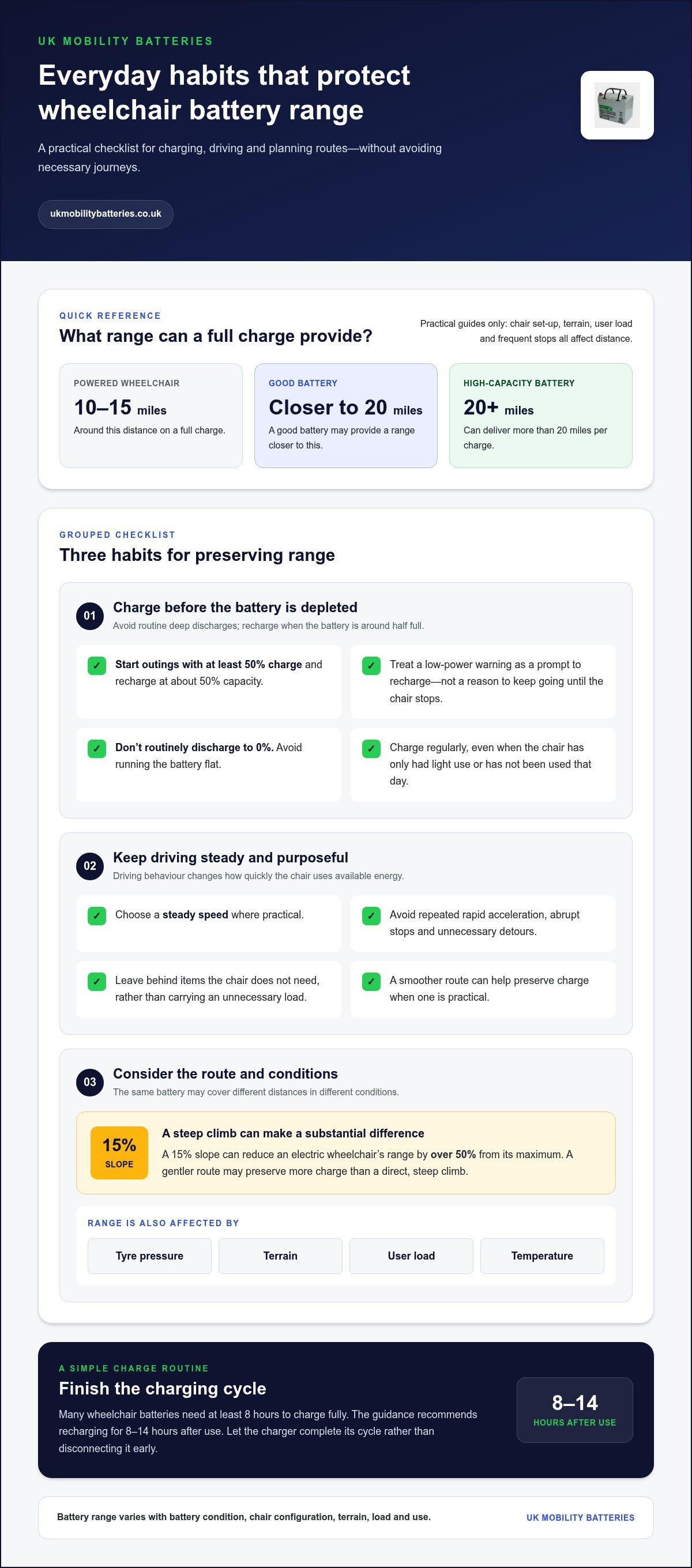
On a full charge, a powered wheelchair may travel around 10-15 miles. A good battery may provide a range closer to 20 miles, whilst high-capacity batteries can deliver 20+ miles per charge. These figures are practical guides, not a measure of every journey: chair configuration, terrain, user load and frequent stops all affect range. Extreme slopes can also reduce distance substantially.
Charge the chair every night, even after light use or when it hasn’t been used that day. Many wheelchair batteries need at least 8 hours to charge fully; the guidance recommends recharging for 8-14 hours after use. Let the charger complete its cycle rather than disconnecting it early. Switch the charger off at the mains before connecting or disconnecting it, and pull the plug, not the cord. Use the manufacturer-provided or approved charger, matched to the battery voltage.
Watch the controller display while travelling. Recharge before the indicator reaches the red lights, and avoid driving when the red lights flash. A low-charge warning means it’s time to recharge, not to test how far the chair will go. To assess capacity, note the distance travelled from a full charge on similar routes and in comparable conditions. A repeated reduction may mean the battery no longer holds its previous charge.
To help maximise battery life, charge regularly, let the charging cycle finish and avoid routinely running the battery flat. For safety, use only a battery and charger that meet the wheelchair manufacturer’s requirements, including voltage and compatibility. An unsuitable combination can affect charging and operation.
In the UK, take used wheelchair batteries to an appropriate battery recycling collection point rather than putting them in household rubbish. Keep damaged or leaking batteries separate from normal waste and handle them carefully, as battery terminals can conduct electricity.
A power wheelchair battery’s estimated overall lifespan is one to two years, with six months given as the minimum. Try to recharge before the controller display reaches the red lights, and normally avoid driving when they flash.
2. Battery storage when a chair is unused
Before parking a wheelchair for an extended period, choose a cool, dry storage place away from direct sunlight, radiators and other heat sources. Aim for 18-25°C; 20-25°C is also given as an ideal room-temperature range for battery storage. Avoid extreme temperatures, which can affect battery condition and reduce its ability to retain charge. Keep the chair and battery dry, and don’t place items on top of the battery.
A parked chair can still lose charge through parasitic drain: electrical components may draw a small current even when the chair isn’t being used. If the wheelchair will remain unused for more than 15 days, disconnect the cable linking its batteries to help limit this drain. Follow the wheelchair’s instructions for disconnecting and reconnecting the cable, and keep the battery terminals protected from accidental contact with metal objects.
Storage doesn’t remove the need to recharge. For infrequent use, charge the batteries for 8-14 hours twice a week. If the chair is unused for more than 15 days, fully charge its batteries at least once a week. These routines reduce the risk of a chair battery remaining depleted whilst parked. Set a reminder in your calendar, then check the charge indicator before connecting the charger.
Use the charger approved for the wheelchair and follow its charging instructions. A 10-amp trickle charger may be considered when a chair will be unused for weeks, but don’t assume every charger is suitable for continuous connection. Some 8-amp chargers may discharge wheelchair batteries if left connected for extended periods. If the charger stays plugged in, ensure its power supply is switched on as directed; leaving its cable connected whilst the supply is off can gradually deplete the battery.
Before storage and at each weekly recharge, inspect the battery case and terminals for corrosion, cracks, swelling or leaks. Don’t use a visibly damaged battery. For sealed lead-acid batteries, don’t open the casing or add water; follow the battery maker’s care instructions instead. If storage continues, keep a simple log of recharge dates and any change in the charge display. That record can help distinguish normal self-discharge from a battery that no longer holds charge reliably. If you’re replacing a battery that has lost capacity, sealed AGM mobility batteries are one option to consider.
3. How can I extend the range and distance of my battery while not limiting use of my chair?
Preserving range doesn’t mean avoiding necessary journeys. A practical part of how to make wheelchair batteries last longer is to recharge when the battery reaches about 50% capacity and start outings with at least 50% charge. Don’t routinely discharge it to 0%. If the low-power warning appears, recharge rather than continuing until the chair stops. These habits reduce deep discharges without requiring you to limit everyday use.
Driving behaviour affects how quickly an electric wheelchair uses its available energy. Repeated rapid acceleration, abrupt stops and unnecessary detours place extra demand on the battery. Choose a steady speed, avoid carrying items the chair doesn’t need, and select a smoother route where practical. A 15% slope can reduce an electric wheelchair’s range by over 50% from its maximum, so a gentler route may preserve more charge than a direct, steep climb.
Tyre pressure, terrain, load and temperature all affect how much effort the chair needs to move. Underinflated tyres increase rolling resistance, while uneven or soft ground can demand more power than a firm, level surface. Carrying extra weight also increases the load on the motor. Hot or cold conditions can affect battery performance, so avoid leaving the chair in direct heat or extreme temperatures. Check tyre condition and pressure against the wheelchair manufacturer’s guidance.
Extension cables add another risk during charging. Use one only when necessary, and keep it away from wheels, walkways and anything that could damage it. Place the charger on a hard, ventilated surface where it cannot be covered. Don’t charge outdoors or expose the charger to water, direct sunlight or heat. A clear, safe charging area also makes it easier to connect the charger correctly after a journey.
Good charging habits can help maintain range without a strict cycle of emptying and refilling the battery. Lithium-ion wheelchair batteries tolerate partial charges and frequent top-ups. For other battery types, follow the wheelchair and charger instructions, and avoid regular full discharges. Charging overnight or after use helps keep the battery near full capacity. Don’t leave the charger cable connected while its power supply is switched off, as this can gradually drain the battery.
To understand how to make wheelchair batteries last longer without restricting trips, track the charge used on familiar routes. Note the distance, terrain and load, then compare journeys in similar conditions. If a familiar trip leaves less charge than usual, consider whether the route or conditions have changed. A persistent decline may indicate reduced battery capacity, helping you distinguish battery ageing from a particularly demanding journey.
4. Battery monitoring and maintenance
Use a simple record to track battery life rather than relying on one journey. Note when the chair reaches a full charge, the distance travelled and the conditions on that trip. Compare similar routes, because hills, surfaces and extra load affect range. A sustained drop of 30% or more in travel range can indicate fading battery performance. A gradual decline across comparable journeys is more useful evidence than one unusually short outing.
Check the battery case and terminals regularly. Look for corrosion or buildup, and inspect the casing for swelling, leaks, dents or cracks. Don’t try to revive a leaking or swollen battery; visible damage means it needs replacing. Don’t attempt to restore an ageing sealed lead-acid battery by applying a higher voltage. This can overheat components and cause leaks or reliability problems.
If corrosion appears, clean the terminals with a wire brush. Baking soda and water can also be used to clean terminals. After cleaning, petroleum jelly can help protect them from further corrosion. Don’t use ordinary oil for this purpose. Limit cleaning to the terminals, and follow the wheelchair and battery instructions for any other maintenance.
Sealed batteries don’t require routine electrolyte servicing. The wheelchair batteries described as gel batteries need regular charging, not water top-ups. Don’t open a sealed case or add distilled water. Some serviceable lead-acid designs differ: their electrolyte levels may need checking, with distilled water added if low. Identify the battery type before carrying out maintenance.
Charging habits remain central to lifespan. Active wheelchair users should charge daily, and regular use with charge-and-discharge cycling can help maintain the battery’s internal chemistry. Avoid leaving a battery on charge for more than 24 consecutive hours. A smart charger can prevent overcharging when used properly, but follow its operating instructions and the wheelchair manufacturer’s guidance.
Compare the display’s charge level with the distance the chair manages after a full charge. If the indicator drops quickly or the chair’s travel range falls by 30% or more, record the pattern and inspect the battery condition. Replace batteries showing physical damage. A noticeable loss of capacity can also point to ageing, especially when charging routines and routes have stayed consistent.
Lithium batteries tolerate frequent partial charging, but care still depends on the charger and wheelchair instructions. Don’t apply lead-acid maintenance steps to lithium batteries. Keeping a record of the battery type, charging habits and range can clarify performance and help identify when routine care no longer restores expected use.
5. Deep-cycle wheelchair batteries
A deep-cycle battery is designed to provide sustained power and tolerate repeated discharging and recharging. This makes it relevant to a mobility chair used for regular journeys. It doesn’t mean you should repeatedly run the battery flat: avoiding deep discharge and charging correctly still matter for its lifespan. Match the battery type and capacity to the wheelchair’s requirements, then follow the recommended charging routine.
Sealed lead-acid power wheelchair batteries that are well maintained can last for 300-500 charge cycles. A cycle refers to the battery being used and recharged; it isn’t the same as a fixed number of days or journeys. Actual use varies with route, load, charging behaviour and battery condition. A deep-cycle label therefore describes intended use, not a promise of a particular range or service life.
For a new power wheelchair battery, fully charge it before use and follow the battery and chair instructions. Guidance for new power chair batteries recommends an initial charge of 18-24 hours. After use, let the charging cycle complete rather than disconnecting it midway or adding a daytime top-up. For the sealed lead-acid charging routine described here, charge in the evening and allow a full overnight charge.
Use a charger approved for the wheelchair and matched to the battery voltage. A charger designed for another battery type may use a different charging profile, affecting safe and effective charging. Keep the charger uncovered on a hard, ventilated surface while it operates. Don’t charge unattended where the charger could be covered, knocked or exposed to moisture.
Battery construction determines what maintenance it needs. Sealed AGM and gel batteries are maintenance-free, so don’t open them to inspect the electrolyte or add water. Some serviceable lead-acid batteries differ: their electrolyte must cover the lead plates, and distilled water is added if the level is low. Identify the battery construction before carrying out maintenance, as opening a sealed unit can damage it.
When comparing deep-cycle batteries, check the wheelchair’s required voltage, battery dimensions, connector arrangement and permitted capacity. A higher capacity figure alone doesn’t confirm compatibility or guarantee more usable range. If the chair uses paired batteries, replace both together to maintain a balanced set. Compare the specifications with the existing battery and the wheelchair’s requirements before choosing a replacement.
A deep-cycle battery can suit regular mobility use when its specifications match the electric wheelchair and it’s charged correctly. Track range and charging behaviour over time: a persistent decline may indicate capacity loss. When choosing a replacement, prioritise compatibility and correct charging over the deep-cycle label alone.
UK Mobility Batteries: Lucas 12V 7Ah Sealed AGM Batteries
UK Mobility Batteries offers Lucas 12V 7Ah Sealed AGM Batteries for wheelchair users looking for a replacement sealed AGM battery. The right choice depends on the wheelchair’s required voltage, battery dimensions, connectors and capacity, so compare these with the existing battery and chair requirements before ordering.
For different requirements, the range also includes a Lucas 12V 9Ah Uprated Sealed AGM Battery, a Lucas 12V 20Ah Mobility Battery and a Lucas 12V 34Ah Sealed AGM Deep Cycle Battery. The deep-cycle option may suit repeated mobility use when its specifications match the chair. Battery type alone doesn’t guarantee a particular range or lifespan; correct fit and charging routine matter too.
Contact UK Mobility Batteries to discuss its wheelchair battery options.
Make your next battery decision with confidence
Keep a simple record of charging habits and changes in everyday performance. This helps you decide whether to adjust your routine or replace the battery, rather than relying on one difficult journey. The advice on how to make wheelchair batteries last longer can also help you assess whether a replacement meets your chair’s electrical and physical requirements.
UK Mobility Batteries offers Lucas 12V 7Ah Sealed AGM Batteries, a Lucas 12V 9Ah Uprated Sealed AGM Battery and a Lucas 12V 34Ah Sealed AGM Deep Cycle Battery. Compare the required voltage, capacity and fit with your wheelchair before choosing. The right specification is the practical starting point for dependable battery use.
Contact UK Mobility Batteries for help choosing from its wheelchair battery options. A considered choice and consistent care can help you plan your next journeys with greater confidence.
Frequently Asked Questions
How long do wheelchair batteries last?
Sealed lead-acid wheelchair batteries usually last 2-3 years with regular use, while lithium-ion batteries can last 3-5 years. Actual lifespan depends on battery condition, charging and how the chair is used. If you’re comparing a recent battery with an older one, assess its ability to hold charge and the distance it provides on familiar journeys, rather than relying on age alone.
How can I extend the range and distance of my battery while not limiting use of my chair?
Use the chair as needed, but avoid routinely discharging its battery fully. For a planned outing, starting with at least 50% charge provides a practical reserve; terrain and load also affect the distance available. If you use a lithium-ion battery, partial charges and frequent top-ups are tolerated. Track a familiar trip over time, because a persistent change under similar conditions can help identify declining capacity.
How often should wheelchair batteries be charged when not in use?
For infrequent use, recharge the batteries for 8-14 hours twice a week. If the wheelchair will remain unused for more than 15 days, fully charge the batteries at least once weekly. Set a recurring reminder and note each charging date, so missed charging intervals are easier to spot. Follow the wheelchair and charger instructions, particularly if the charger is left connected during storage.
How can you tell when wheelchair batteries need replacing?
A repeated range reduction of 30% or more can signal fading battery performance. Other warning signs include a charge display that falls unusually quickly after charging, less distance on familiar routes, or visible swelling, leaks, dents or cracks. Don’t attempt to revive a swollen or leaking battery. If a chair uses two batteries, replace both together rather than pairing a new battery with an ageing one.
What battery maintenance and storage steps are recommended by wheelchair manufacturers?
Use the charger approved for the wheelchair, keep the battery securely fitted, and store the chair in a cool, dry place away from direct sunlight and heat. Inspect the casing and terminals for damage or corrosion. Don’t open sealed AGM or gel batteries or top them up with water. Battery designs differ, so follow only the cleaning and maintenance instructions for the specific battery.