
How to Choose the Right Ah for Your Mobility Scooter
A higher Ah battery isn’t automatically the better choice for your mobility scooter. If you’re wondering how to choose the right Ah for my mobility scooter, start with the journeys you usually make, not the biggest capacity you can find. Ah indicates a battery’s capacity, but it doesn’t guarantee a particular distance on a charge.
You’ll want enough capacity for your regular trips while making sure the battery suits your scooter and charging routine. The right choice depends on the scooter’s requirements, how far and how often you travel, and when you can recharge. A higher Ah rating may be useful, but only if the battery is compatible and fits correctly.
This guide explains what Ah tells you, what it doesn’t, and how to weigh capacity against everyday use. Before ordering, compare voltage, battery dimensions, type, terminals and charger compatibility. Checking the full specification helps you decide whether to match your existing rating or consider another capacity, without assuming a larger battery will suit every scooter.
Key Takeaways
- Learn how to choose the right Ah for my mobility scooter by starting with its manual or current battery specifications.
- Assess your usual journey length, how often you travel, passenger and carried load, and charging routine before comparing capacities.
- A higher Ah rating may offer more capacity, but it won’t suit every scooter. Fit and compatibility still matter.
- Check voltage, dimensions, terminal type, battery chemistry and charger compatibility before ordering.
- Once you know your scooter’s requirements, compare suitable options in UK Mobility Batteries’ sealed AGM range of 7Ah to 150Ah.
What Does Ah Mean on a Mobility Scooter Battery?
Amp-hours (Ah) measure a battery’s capacity, or the amount of electrical charge it can supply over time. They don’t guarantee a set travel distance. As a simplified illustration, a 10Ah rating represents a capacity equivalent to supplying 10 amps for one hour, although actual battery performance depends on operating conditions. The What is an Ampere-hour (Ah)? reference explains the unit in more detail.
Ah and voltage describe different battery characteristics. Ah indicates capacity, while voltage describes electrical potential. Both matter when selecting a replacement: a higher Ah figure doesn’t make a battery with the wrong voltage suitable for your scooter. Use the voltage specified by the scooter manufacturer.
How does Ah affect mobility scooter range?
With other factors equal, greater available capacity can support longer use between charges. However, Ah can’t be converted into a guaranteed mileage figure. The distance you achieve also depends on scooter efficiency, passenger and carried load, terrain, speed and riding conditions. Frequent starts, slopes and rough surfaces can affect use compared with steady travel on level ground.
Think of Ah as one part of range planning, not a promise of how far the scooter will travel. Two scooters using batteries with the same Ah rating may achieve different distances, and one scooter’s range can vary from journey to journey. Your usual routes and charging habits will help you judge how much capacity you need.
Is a higher Ah rating always better?
No. A higher rating may provide more capacity between charges, but only if the scooter’s design and manufacturer requirements allow that battery. Batteries with greater capacity can also differ in physical size, so a higher Ah option might not fit the battery compartment. Charger compatibility matters too.
Start with the specification in your scooter manual or on the existing battery before comparing alternatives. That gives you a reliable reference point. Don’t assume that any battery with a higher Ah rating is a suitable upgrade. Weigh your usual journeys against the scooter’s requirements, then check the replacement’s complete specification. That’s the practical basis for working out how to choose the right Ah for my mobility scooter.
How to Choose Mobility Scooter Ah for Your Typical Journeys
Your regular journey pattern is a better starting point for choosing Ah than an occasional longest trip. First establish the scooter’s requirements, then consider how far and how often you travel, what the scooter usually carries, and when you can recharge. This helps you compare capacity options based on everyday use instead of guesswork.
What information should you gather before comparing Ah?
Start with the scooter manual or the label on the current battery. Record its voltage and Ah rating, then note the scooter’s make and model and the manufacturer’s stated battery requirements. This gives you a reference point for comparing replacements. A battery isn’t suitable just because its Ah rating is close to the one you have.
Next, map out typical use. Consider the length and frequency of regular outings, the usual passenger and carried load, and the conditions of your routes. Assess ordinary trips first instead of relying only on a longest journey you make occasionally. If your travel varies, note both your typical routine and the times when you use the scooter more often.
- Check the manual and current battery. Record the existing voltage and Ah, then identify the manufacturer’s requirements for replacements.
- Describe your normal journeys. Consider how far you usually travel and whether outings are spread across the week or clustered together.
- Account for load and route. Include passengers or carried items, and note whether regular journeys involve slopes or other demanding conditions.
- Compare capacity within the scooter’s limits. Consider how much capacity your routine calls for, but treat compatibility as essential before choosing a different Ah rating.
How should charging habits affect your capacity choice?
Consider how much time you have to recharge between outings. If you can recharge after each use, a battery that supports your regular journeys may suit your routine. If you often travel on consecutive days or can’t charge between trips, usable capacity may matter more, provided the scooter’s specifications allow the option you’re considering.
A higher Ah rating isn’t a substitute for suitable charging and battery care. Follow the scooter and battery instructions, and check that the charger is compatible before choosing a different capacity. These details help you decide whether a potential upgrade suits both your routine and your scooter.
In short, let your usual journey pattern guide the Ah you consider, then make scooter compatibility the deciding condition. Once you’ve recorded the requirements, compare mobility battery capacity options as part of working out how to choose the right Ah for my mobility scooter.
Can You Fit a Higher-Ah Battery to a Mobility Scooter?
Sometimes, but a higher Ah rating isn’t automatically compatible with every scooter. Ah alone cannot confirm battery compatibility. The scooter’s voltage, battery type, permitted configuration and physical space all matter. A battery with more capacity may support longer use between charges, but only if it meets the scooter manufacturer’s requirements and can be installed correctly.
Use this comparison as a starting point, not as a fitment guide. The practical result depends on your scooter’s specifications.
| Capacity choice | Potential benefit | Trade-off to consider |
|---|---|---|
| Lower Ah than the current battery | May be suitable if the manufacturer permits it and your journeys need less capacity. | Could mean less usable time between charges. |
| Matching Ah | Maintains the battery capacity specified for the existing setup. | The replacement still needs to match the other required specifications. |
| Higher Ah | May provide more capacity between charges if the scooter supports the upgrade. | Could be too large or otherwise unsuitable for the scooter or its charging system. |
What must match before you upgrade battery capacity?
Check the scooter manual for the specified voltage, battery type and permitted capacity or configuration. Compare the replacement’s dimensions and terminal layout with the existing installation. A battery that appears suitable by Ah may still be incompatible if its terminals are arranged differently or it doesn’t fit securely in the compartment.
Use the manufacturer’s guidance as the deciding reference rather than assuming a similar scooter can take the same upgrade. RESNA’s resource on wheelchair and related seating standards offers broader context on standards for mobility devices. It doesn’t replace your scooter’s own battery specifications. These checks are central to how to choose the right Ah for my mobility scooter.
Why might mobility scooter batteries need replacing in pairs?
Some scooters use two batteries as a matched set, while others have a different arrangement. If your scooter uses a pair, follow its instructions for replacement rather than changing only one battery by default. The right approach depends on the scooter and its battery setup, so check the manual before ordering.
Consider a higher Ah option only after confirming it falls within the scooter’s permitted specification and suits the installation. Then compare the full replacement details, not just the capacity figure.
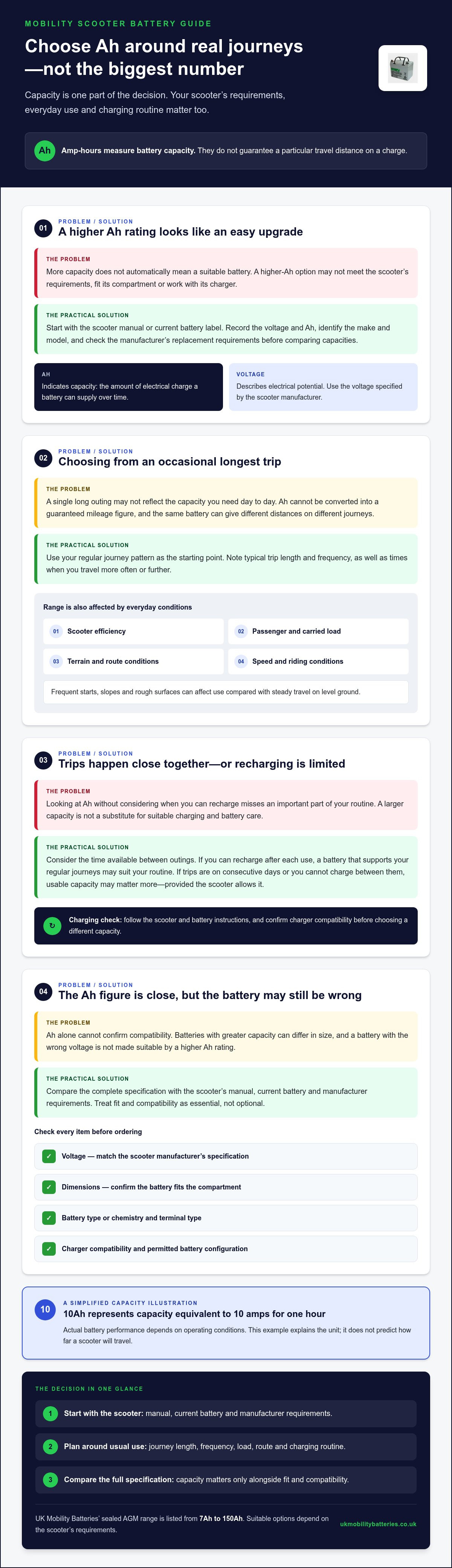
What to Check Before Ordering a Mobility Scooter Battery by Ah
Use this checklist to compare a replacement with the scooter manual and existing battery before ordering. Ah alone isn’t enough to establish a correct match. A battery with your preferred capacity still needs to meet the scooter’s electrical, physical and charging requirements. These checks turn how to choose the right Ah for my mobility scooter into a complete compatibility decision.
- Voltage: Match the voltage specified by the scooter manufacturer and shown on the existing battery.
- Ah rating: Compare capacity with the manual’s requirements and any permitted options.
- Dimensions: Check that the replacement’s length, width and height fit the battery compartment.
- Terminal type and position: Compare the terminals with the existing battery and scooter documentation.
- Battery chemistry: Check that the battery type is suitable for the scooter and its charging system.
- Charger compatibility: Follow the scooter and charger instructions before using a replacement.
How do you confirm the battery dimensions and terminals?
Measure the existing battery’s length, width and height, then compare each measurement with the replacement specifications. Check the terminal type and position as well. A battery can fit the available space but still be unsuitable if its connections don’t match the scooter. Use the manual or existing installation as a reference. A 12V 7Ah battery specifications and fitting guide can provide a practical example of the details to compare. For a broader overview, refer to a mobility scooter battery sizes guide.
Will your existing charger work with the replacement?
Not necessarily. Charger compatibility depends on the battery type and the manufacturer’s guidance, so don’t assume the current charger will suit a replacement with different chemistry or capacity. Check both the scooter and charger instructions before charging a new battery. A mobility scooter battery charger compatibility guide can help you understand which specifications to compare.
Before ordering, make sure every item on the checklist aligns with the scooter’s requirements. If one detail differs, don’t rely on the Ah rating alone to decide the battery will work. Once you’ve established the required specifications, browse mobility battery options and compare suitable capacities.
Choosing a Suitable Ah Battery from UK Mobility Batteries
Make the decision in order: establish the scooter’s required specifications, assess your usual journeys and charging routine, then compare Ah options that meet the scooter’s requirements. This keeps capacity in context. The largest Ah rating isn’t automatically the right choice if the battery doesn’t match the scooter.
UK Mobility Batteries’ sealed AGM range spans 7Ah to 150Ah, giving you capacities to compare once you know what your scooter can use. The range includes Lucas options, and expert technical support can help you understand listed specifications as you narrow down a suitable comparison.
How to narrow down the available Ah options
Begin with the scooter manual, battery label and manufacturer’s guidance. Note the required voltage, battery type and permitted capacity or configuration. From there, consider only options with suitable dimensions and terminal configuration. Finally, use your normal journeys and charging habits to decide what capacity to compare. This sequence is a practical way to approach how to choose the right Ah for my mobility scooter without treating Ah as the only deciding factor.
For wider background on battery types and specifications, consult the ultimate guide to mobility scooter batteries in the UK. Use it alongside your scooter’s own requirements, rather than as a substitute for them.
What should you do if the specifications are unclear?
Check the scooter manual, the label on the existing battery and the manufacturer’s documentation again. Record the details you can identify, including voltage, Ah, battery type and physical measurements. UK Mobility Batteries’ expert technical support can help you understand listed battery specifications so you can make a more informed comparison. Use the scooter’s requirements to determine which capacities are suitable.
If your concern is battery condition as well as capacity, the mobility scooter battery troubleshooting guide may help you think through the symptoms. A capacity choice won’t, by itself, explain every performance issue.
Once you have the scooter’s requirements and a realistic view of your use, compare batteries by their complete specifications, not by Ah alone. Browse mobility batteries and compare specifications to explore the available options.
Make Your Next Battery Choice with Confidence
The right Ah rating starts with your scooter’s requirements, then your usual journeys and charging routine. Ah indicates capacity, not guaranteed range, and a higher rating is only worth considering when the complete battery specification is suitable. That’s the practical answer to how to choose the right Ah for my mobility scooter.
UK Mobility Batteries offers sealed AGM mobility batteries from 7Ah to 150Ah, including Lucas options, with expert technical support and delivery across the UK. Compare capacity only after checking the voltage, battery type, dimensions, terminals and charger requirements for your scooter.
Browse UK Mobility Batteries’ mobility scooter batteries and compare the specifications to explore the available options. With the right details in hand, you can make a considered choice for your scooter and everyday use.
Frequently Asked Questions
How do I know what Ah battery my mobility scooter needs?
Start with the scooter manual and the label on the current battery. Check the specified voltage, Ah rating, battery type and any manufacturer guidance on permitted replacements. Then consider your regular journey length, how often you travel, typical load and opportunities to recharge. This is the practical way to decide how to choose the right Ah for my mobility scooter. Compare capacities only among batteries that meet the scooter’s other requirements.
Can I replace a 42Ah mobility scooter battery with a 50Ah battery?
Possibly, but a 50Ah battery isn’t automatically a suitable replacement for a 42Ah battery. Check that the scooter manufacturer permits the capacity, and that voltage, battery type, dimensions, terminal arrangement and charger compatibility meet the scooter’s requirements. If the scooter uses a paired battery setup, follow its instructions for replacing the pair. A higher Ah rating may provide more capacity between charges, but it can’t confirm compatibility by itself.
Is a higher Ah battery always better for a mobility scooter?
No. A higher Ah rating may provide more capacity between charges, but it’s only useful if the scooter supports that battery and it fits the installation. The manufacturer’s permitted capacity, voltage, battery chemistry and charger requirements all affect suitability. A higher-capacity battery may also have different dimensions. Choose around your normal journeys and charging routine, then verify the full specification rather than selecting the highest Ah figure available.
Do mobility scooter batteries need to be replaced in pairs?
Not every scooter uses a pair, so replacing two batteries isn’t a universal requirement. Some models use two batteries as a matched set. If yours does, follow the scooter manual’s instructions for replacement. Check the battery arrangement and manufacturer guidance before ordering, rather than assuming that one battery can be changed independently or that every scooter needs a pair. The right approach depends on the scooter’s design and battery configuration.
Will a higher Ah battery give my mobility scooter more range?
A higher Ah battery can provide more capacity between charges, which may support longer use if the scooter is compatible with it. It won’t guarantee a particular increase in travel distance. Range also varies with scooter efficiency, load, terrain, speed and riding conditions. Check the manufacturer’s requirements and compare the battery’s complete specifications before considering an upgrade. Treat Ah as one factor in range planning, not as a direct mileage promise.
Can I use my existing charger with a different Ah battery?
Only if the charger is compatible with the replacement battery and the scooter manufacturer’s instructions allow its use. Compatibility can depend on battery chemistry as well as the scooter’s charging requirements, so don’t assume a charger will work simply because the new battery has the same voltage. Check the charger and scooter documentation before charging a replacement. If you’re changing battery type or capacity, verify the guidance for both components first.