
How Long to Charge a 75Ah Wheelchair Battery? A Practical Guide
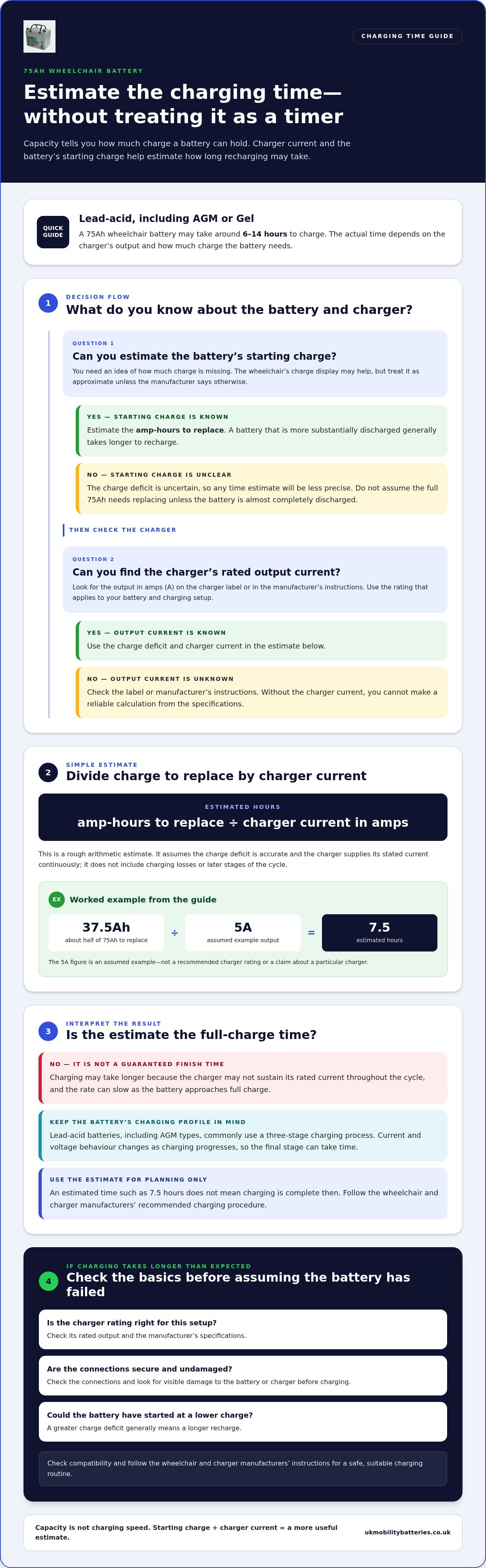
A 75Ah wheelchair battery doesn’t have one fixed charging time. If you’re asking how long to charge a 75ah wheelchair battery, a lead-acid battery, including AGM or Gel, may take around 6-14 hours. The actual time depends on the charger’s output and how much charge the battery needs.
It’s easy to expect the 75Ah rating to give you a clear answer. It describes battery capacity, not charging speed. As a rough starting point, divide the amp-hours that need replacing by the charger’s rated output in amps. In practice, charging can take longer because the rate may slow as the battery approaches full charge.
This guide explains how to estimate charging time from the battery and charger specifications, why the actual duration can vary, and how to charge safely. It also covers what to check if charging takes much longer than expected, so you can distinguish normal charging behaviour from a possible battery or charger issue.
Key Takeaways
- To estimate how long to charge a 75ah wheelchair battery, consider how much charge the battery needs and the charger’s current, then allow for charging losses and later charging stages.
- Use the battery’s starting charge level and condition to refine your estimate. Two batteries with the same capacity may take different times to charge.
- Before charging, check that the charger is compatible and that the connections and battery show no visible damage.
- Follow the wheelchair and charger manufacturers’ instructions for a safe, suitable charging routine.
- If charging takes longer than expected, check the charger rating, connections and starting charge level before assuming the battery has failed.
How Long Does It Take to Charge a 75Ah Wheelchair Battery?
You can’t calculate a precise charging time from a 75Ah rating alone. The elapsed time depends on how much charge the battery needs, the charger’s current output and the battery’s charging profile. A substantially discharged battery will generally take longer to recharge than one that has only been partly used. Charging may also slow as the battery approaches full charge.
Battery capacity tells you how much charge a battery can hold; charger current tells you how quickly charge is supplied. That distinction is central to working out how long to charge a 75ah wheelchair battery. The capacity figure is one part of the calculation, not a guaranteed number of hours.
What does 75Ah mean on a wheelchair battery?
Amp-hours, written as Ah, describe electrical capacity. In simple terms, 75Ah indicates the battery’s rated capacity: the amount of charge it can supply under specified test conditions. It doesn’t mean the battery will recharge in 75 hours, or that every charger will replenish it at the same rate.
Think of Ah as a measure of stored capacity, not charging speed. A battery’s usable capacity and performance can also change with its condition and how it has been used. As a result, two batteries labelled 75Ah may behave differently during everyday use and recharging.
Why is there no single charging-time answer?
Three details matter most: the charger’s current, the battery’s state of charge when charging begins, and the battery’s charging stages. A charger may deliver different current at different points in the cycle, so dividing capacity by charger output gives only a rough indication, not a dependable full-charge time.
Lead-acid batteries, including AGM types, commonly use a three-stage charging process. The current and voltage behaviour changes as charging progresses, so the final stage can take time even after the battery has received most of its charge. The exact profile depends on the battery and charger specifications.
A fixed answer without those specifications could therefore mislead. The 75Ah rating doesn’t tell you how depleted the battery is, what current the charger supplies throughout the cycle, or how the battery responds as it charges. Check the labels and manufacturer instructions for both components before judging whether the duration is normal.
Use capacity as a starting point, then consider the charger rating and the battery’s condition. Estimate the charge needed and allow for charging behaviour, rather than treating the Ah figure as a direct timer.
How to Estimate Charging Time for a 75Ah Wheelchair Battery
A useful estimate starts with the charge the battery needs, not its full 75Ah capacity unless it is almost completely discharged. Divide the amp-hours to replace by the charger’s current in amps. Then allow for charging losses and later stages of the cycle, when the current may reduce. The result is a planning estimate, not a guaranteed time to full charge.
Find the battery’s current charge level and charger output
Check the charger label or its manufacturer instructions for the rated output current, shown in amps (A). Use the rating that applies to your battery and charging setup. The battery label and manufacturer guidance give you its capacity and charging requirements.
Next, estimate how much charge is missing. The wheelchair’s charge display may help, but treat it as an approximate indication unless the manufacturer states otherwise. If you can’t establish the starting charge level, you can’t reliably calculate the charge deficit, so any time estimate will be less precise.
Apply the estimate without treating it as an exact timer
Estimated hours = amp-hours to replace ÷ charger current in amps. This calculation assumes the estimated charge deficit is accurate and the charger supplies its stated current continuously. It excludes charging losses and later stages, so it isn’t a full-charge prediction.
For an arithmetic illustration, suppose the battery needs about half of its 75Ah capacity replaced. That gives an estimated deficit of 37.5Ah. If, purely for this example, the charger label states an output of 5A, the simple calculation is 37.5Ah ÷ 5A = 7.5 hours. The 5A figure is an assumed example, not a recommended charger rating or a claim about a particular charger.
Actual charging can take longer. The charger may not sustain its rated current throughout the cycle, and the battery’s charging profile can reduce the rate as it approaches full charge. The calculation also doesn’t account for the battery’s condition or the accuracy of your estimate of its starting charge. Don’t add an arbitrary number of hours and treat the result as precise. Use the battery and charger manufacturers’ guidance for expected charging behaviour.
Use this method to understand the likely scale of the wait, not to decide when to disconnect the charger. An estimated 7.5 hours in the example doesn’t mean charging is complete at that point. Follow the manufacturer’s recommended charging procedure and any instructions from the wheelchair manufacturer. The estimate and the prescribed procedure serve different purposes.
Matching battery capacity and charger specifications is also important when selecting a replacement. For practical guidance on mobility battery options and specifications, explore mobility batteries and technical support.
What Changes the Charging Time of a 75Ah Wheelchair Battery?
Two wheelchair batteries marked 75Ah won’t necessarily take the same time to charge. Capacity alone doesn’t tell you how much charge needs replacing, the current the charger supplies throughout the cycle, or how the battery responds. Battery chemistry and the manufacturer’s charging profile matter too, so don’t compare charging times without considering the battery and charger specifications.
Use the factors below to understand why your estimate may differ from the time you observe. Each one gives you a practical point to check before assuming that a long charging cycle means something is wrong.
| Factor | How it can affect charging time | What to check |
|---|---|---|
| Charger current | A charger with a higher suitable output may replace charge more quickly at some stages, but it may not supply that current continuously. | Find the output rating in amps on the charger label and read the manufacturer’s instructions. |
| Starting charge level | A larger charge deficit generally takes longer to replace than a small one. | Use the wheelchair’s charge indicator as a guide, while recognising that it may not show an exact percentage. |
| Battery condition | Age, condition and previous use may affect how the battery accepts and holds charge, changing its charging behaviour. | Consider the battery’s history and check its manufacturer guidance if charging behaviour has changed. |
| Chemistry and charging profile | Different battery chemistries can have different charging requirements and stages. A profile intended for one type may not suit another. | Match the charger to the battery type and follow both manufacturers’ instructions. |
How charger current and starting charge level affect the estimate
The charger’s amp rating is useful, but it’s only one input. Its output can change as charging progresses, so don’t assume the stated current is delivered at a constant rate until the battery is full. Starting charge matters too: a battery that has been used extensively has more charge to replace than one that began the session partly charged.
How battery condition and charging profile affect duration
A battery’s age and past use may influence its performance, but a longer charging time alone doesn’t establish that it has failed. Sealed AGM batteries and other chemistries can have different charging requirements. Follow the instructions for the specific battery and compatible charger; don’t apply universal voltage or current settings.
For a more useful comparison, record the charger rating, approximate starting charge and time taken over several normal charging sessions. Keep the setup and conditions as consistent as possible. If the time changes noticeably, check that the connections are secure and consult the battery and charger guidance before drawing conclusions.
These variables explain why how long to charge a 75ah wheelchair battery can’t be answered by capacity alone. Compare like with like: the same battery type, a similar starting charge and the correct charger profile. That gives you a more meaningful basis for judging whether a charging duration is usual for your equipment.
How to Charge a 75Ah Wheelchair Battery Safely
A safe charging routine starts with compatibility, not the plug. A connector that fits doesn’t prove that the charger’s voltage or charging profile is suitable for the battery. Follow the wheelchair, battery and charger manufacturers’ instructions, particularly if their guidance differs from a general rule. Never use the wheelchair whilst it’s charging.
Check charger compatibility before connecting
Confirm that the charger is intended for the battery’s chemistry and matches the battery maker’s stated charging requirements. Use the instructions for your exact charger and wheelchair to identify the correct output details. A mobility scooter battery charger compatibility guide can help explain what to compare.
Use this routine, adjusting it to the equipment manuals:
- Switch off the wheelchair and place it in a suitable charging area with ventilation. Keep flammable materials away.
- Check the battery and charger for visible damage, and make sure the charging socket and connectors are clean and secure. Don’t proceed if a component appears damaged.
- Confirm the charger is compatible with the battery and wheelchair, including the specified voltage and charging profile.
- Connect the charger in the order given in its instructions. Connection sequences can differ, so don’t assume one method applies to every model.
- Monitor the charger as directed, then disconnect it according to the manufacturer’s procedure once charging is complete.
Monitor the charge and interpret completion indicators
Indicator lights and completion signals aren’t standard across charger models. A particular colour may mean charging on one unit and a different status on another. Read the charger’s manual to identify its charging, complete and fault indications. Don’t infer that the battery is full from a colour alone. If the signal doesn’t match the manual or the charger displays a fault, follow the manufacturer’s troubleshooting steps.
For the same reason, an estimate of how long to charge a 75ah wheelchair battery shouldn’t replace the charger’s completion instructions. Charging duration varies with the battery’s starting charge and charging process. Use an estimate to plan, then rely on the specified indicators and procedure to determine when to stop.
To reduce avoidable charging problems, use the compatible charger and follow the manufacturer’s instructions. The guide to avoiding battery overcharging covers related battery-care considerations.
If you’re choosing a replacement, accurate battery capacity and charger matching are essential. Explore mobility battery options from a specialist retailer focused on wheelchair and mobility scooter batteries.
When a 75Ah Wheelchair Battery Takes Longer Than Expected
A charging time that exceeds your estimate doesn’t, by itself, prove the battery has failed. The estimate may not account for the starting charge level, charging stages or the battery’s condition. Check the equipment and instructions before drawing conclusions or changing the charging routine.
What to check before assuming the battery has failed
Work through these checks first, without altering the manufacturer’s recommended charging procedure:
- Charger rating and compatibility: Read the charger’s output rating and confirm it’s intended for the battery type and wheelchair. A charger that fits the socket may still be unsuitable.
- Connections: Check that the charger is connected as instructed and that the plug and charging socket appear secure and undamaged.
- Starting charge: Consider whether the battery began deeply discharged or had been used heavily. A larger charge deficit can mean a longer session than a rough estimate suggests.
- Manufacturer guidance: Check the charger’s indicators and troubleshooting instructions, alongside the wheelchair and battery manuals. Indicator meanings vary by model.
If the charger signals a fault, or charging behaviour remains unusual after these checks, follow the manufacturer’s safety and troubleshooting guidance. A mobility scooter battery troubleshooting guide may also help you assess related symptoms.
Stop charging if you notice visible battery damage, leakage, swelling, unusual heat or a strong unusual smell. Don’t continue using the charger or battery until you’ve followed the relevant manufacturer’s safety instructions. Keep the charging area ventilated and clear of flammable materials, and don’t use the wheelchair whilst it’s charging.
How to choose a suitable replacement battery
If the manufacturer’s guidance indicates that a replacement is needed, match the battery to the wheelchair rather than choosing by capacity alone. Check the required voltage, approved capacity, physical dimensions and terminal type. The replacement must also be compatible with the wheelchair’s charging system, as a different capacity or chemistry can have different charging requirements.
Use the wheelchair manual or existing battery details to identify the specification. If information differs between the battery and wheelchair instructions, follow the guidance provided for the equipment and its approved battery setup. A broader electric wheelchair battery buying guide can help you compare the selection factors.
If you’re still asking how long to charge a 75ah wheelchair battery, remember that a longer-than-estimated session is a reason to check the setup, not an automatic diagnosis. UK Mobility Batteries specialises in wheelchair and mobility scooter batteries, with sealed AGM options across a stated 7Ah-150Ah range and expert technical support. Browse mobility battery options with capacity and charger compatibility in mind.
Make your next battery decision with confidence
Use your next charging session to build a useful reference for future planning. Note the charger’s output, the battery’s starting charge indication and the time taken to reach the charger’s stated completion signal. These details can help you recognise your equipment’s usual behaviour and make future estimates more relevant.
If you’re considering a replacement, record the wheelchair’s required voltage, permitted capacity, battery dimensions and terminal type before comparing options. The search for how long to charge a 75ah wheelchair battery is only one part of choosing a suitable setup. Matching the replacement to the wheelchair and charger keeps the decision grounded in the equipment’s requirements.
UK Mobility Batteries specialises in wheelchair and mobility scooter batteries, with sealed AGM options across a stated 7Ah-150Ah range and technical support for customers across the UK. Browse mobility batteries and find practical product information to inform your next step. With the right specifications to hand, you can make a more confident choice.
Frequently Asked Questions
How long does it take to charge a 75Ah wheelchair battery fully?
There’s no single full-charge time for every 75Ah wheelchair battery. The battery type, its starting charge and the compatible charger all affect the duration. Lead-acid batteries, including AGM and Gel, typically take around 6-14 hours to charge, but this is a general range, not a guarantee for a particular wheelchair setup. Follow the battery and charger instructions to identify the expected charging behaviour and completion signal for your equipment.
Can I charge a 75Ah wheelchair battery with a lower-amp charger?
Possibly, but only if the charger is compatible with the battery and wheelchair. A lower suitable current may mean a longer charge, but the charger must also meet the battery maker’s voltage and charging-profile requirements. Don’t use a charger simply because its connector fits, or assume that a lower rating is automatically safe. Check the manuals for both the charger and wheelchair before charging.
Does a 75Ah battery take longer to charge than a 50Ah battery?
It may take longer if both batteries start at a similar charge level and use compatible chargers with comparable output. The larger capacity can mean more charge to replenish, but capacity alone doesn’t determine the result. A partly charged 75Ah battery could take less time than a deeply discharged 50Ah battery. Compare the battery type, charge deficit and charger specifications before using charging times as a guide.
How do I calculate charging time from the charger’s amp rating?
Divide the estimated amp-hours needed to replenish the battery by the charger’s output in amps. Use the charge deficit rather than the full battery capacity if it wasn’t completely discharged. This gives a simplified estimate, not a full-charge guarantee: charger output can change during charging, and charging losses and later stages add time. Check the charger label and manufacturer instructions for the applicable output rating.
Is it normal for a wheelchair battery to take longer to charge as it gets older?
Charging behaviour can change as a battery ages or its condition changes, but a longer session alone doesn’t confirm that it has failed. Compare similar charging sessions and note the starting charge, charger used and completion indicator. If the battery consistently behaves differently, consult its manufacturer’s troubleshooting guidance. Also make sure the charger remains compatible and connections are secure before concluding that age is the cause.
Can I leave a wheelchair battery charging overnight?
Only do so if the wheelchair and charger manufacturers’ instructions permit it and explain how charging completion is indicated. Use the correct charger in a ventilated area, keep flammable materials away and don’t use the wheelchair while it’s connected. Don’t assume every charger stops or manages charging in the same way. Follow the specific model’s instructions for monitoring and disconnecting.
What should I do if my wheelchair battery will not reach a full charge?
Check the charger’s compatibility and status indicators, then inspect the plug and socket for a secure connection and visible damage. Review the manual for the meaning of any fault signal and follow its troubleshooting steps. If the battery is damaged, unusually hot, swollen or leaking, stop charging and follow the manufacturer’s safety guidance. Persistent incomplete charging needs further assessment using the battery and wheelchair instructions.