
Helping an Elderly Parent Buy Scooter Batteries: A Practical UK Guide
What if the best replacement battery isn’t the one with the highest capacity, but the one that matches your parent’s scooter and daily routine? Helping an elderly parent buy scooter batteries can feel technical, especially when you want to avoid a costly mismatch and keep the decision centred on their needs.
Before comparing options, check the details. A battery can look suitable but still have the wrong voltage, capacity, dimensions or terminal type. Your parent’s usual journeys and charging routine also matter, but they don’t replace the scooter’s technical requirements.
This guide offers a practical, parent-centred checklist. You’ll learn how to find the existing battery specification, compare it with the scooter’s requirements and consider suitable sealed AGM replacements. It also covers questions to discuss together, so your parent can stay involved and you can make a more informed choice.
Key Takeaways
- Discuss your parent’s usual journeys and charging routine so the replacement suits how they use the scooter.
- Use the scooter manual and existing battery label to record the required voltage, Ah capacity, dimensions and terminal layout.
- Compare sealed AGM options with the scooter’s stated requirements. A higher Ah rating isn’t automatically a suitable replacement.
- Before ordering, check the required battery quantity and charger compatibility, then review the details with your parent.
- Helping an elderly parent buy scooter batteries is easier when you understand their routine, confirm the specification and compare suitable batteries in that order.
Helping an elderly parent buy scooter batteries starts with their routine
A replacement battery affects everyday scooter use, from shopping trips to visiting friends or attending appointments. Start by asking what your parent wants the scooter to keep doing, rather than making assumptions based on their age, health or independence. Their actual routine is the most useful starting point.
Ask about the routes they take, how far they usually travel and how often they use the scooter. Find out how they charge it and whether their journeys have changed. These details help you understand their priorities, but they don’t replace the scooter’s technical requirements. Confirm compatibility before comparing capacity or price.
What should you ask your parent before buying?
Keep the conversation practical, and let your parent choose how much they want to be involved in researching and comparing options. You could ask:
- Where do you usually use the scooter, and how often do you go out?
- Have your routes or journey lengths changed?
- What feels difficult at the moment: shorter range, charging, lifting the battery or uncertainty about its performance?
- Would you like to compare options together, or would you prefer me to gather the details first?
Listen for specific difficulties rather than treating age or disability as a guide to what your parent needs. If lifting is a concern, for example, note it as a practical consideration for the comparison. Don’t assume that a different battery type will fit or be suitable.
When is a replacement battery worth investigating?
Shorter range or inconsistent performance can be a reason to investigate, but neither proves that the battery has failed. Changes in use or charging, or another scooter fault, may also be involved. Avoid diagnosing the cause from a distance. Note when the problem occurs and what has changed, then use those observations to guide your next checks.
If you’re helping an elderly parent buy scooter batteries, keep observations separate from conclusions. The mobility scooter battery troubleshooting guide can help you consider possible signs and causes. Battery chemistry is another detail to explore; this overview of rechargeable battery types explains general differences between technologies such as lead-acid and lithium-ion.
First, record your parent’s routine and concerns. Then identify the scooter’s exact battery requirements. This order keeps their needs in view while grounding your comparison in compatibility.
Check scooter battery compatibility before comparing replacements
Once you’ve noted how your parent uses the scooter, find out which battery specifications it requires. A familiar shape or similar-looking battery isn’t enough: scooters can have different electrical and physical requirements. Check the scooter manufacturer’s guidance before comparing capacity or price. This gives you a sound basis for helping an elderly parent buy scooter batteries.
Where can you find the battery details?
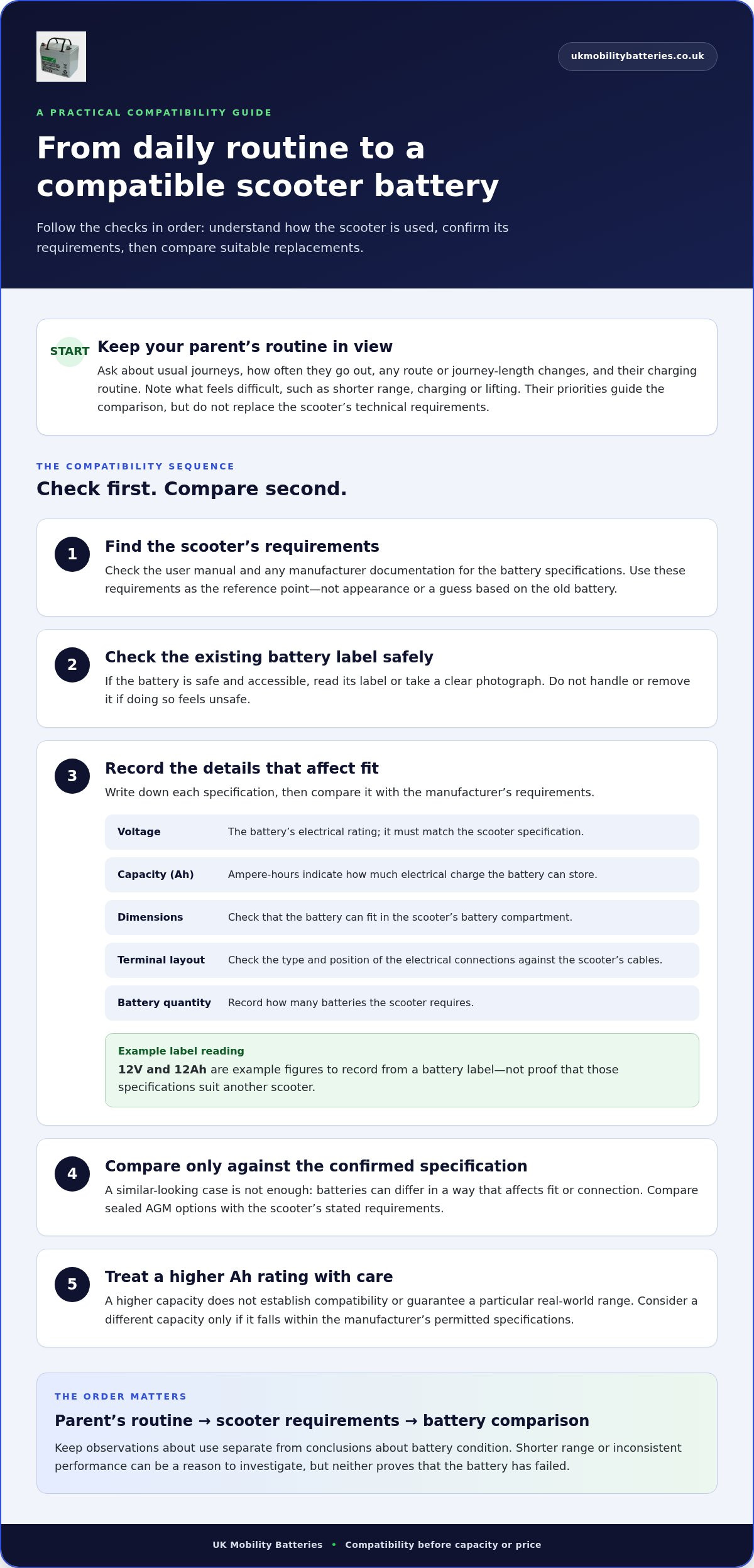
Use this sequence to build a clear specification record:
- Find the manual. Check the scooter’s user manual and any manufacturer documentation for its battery requirements.
- Inspect the existing battery label. If it’s safe and accessible, read the label or take a clear photograph. Don’t handle or remove a battery if doing so feels unsafe.
- Record each detail. Note the voltage, ampere-hour (Ah) rating, dimensions, terminal layout and number of batteries. Compare these details with the manufacturer’s stated requirements.
Dimensions tell you whether the battery can fit in the scooter’s battery compartment. The terminal layout describes the type and position of its electrical connections, which need to suit the scooter’s cables. Don’t rely on the case shape alone. Two batteries can look alike but differ in a detail that affects fit or connection.
What do voltage and ampere-hours tell you?
Voltage is the battery’s electrical rating and must match the scooter’s specification. Ampere-hours (Ah) indicate capacity, or how much electrical charge the battery can store. A higher Ah figure doesn’t guarantee a particular real-world range, and it doesn’t establish compatibility on its own. The scooter’s requirements, battery dimensions and terminal arrangement still need to match.
For example, if the existing battery label states 12V and 12Ah, record those figures exactly, along with the measurements and terminal details. Treat them as information about that battery, not proof that the same specifications will suit another scooter. The mobility scooter battery selection and performance guide offers more detail on interpreting battery information. For separate guidance on legal scooter classes, see the UK government rules for mobility scooters. A class label doesn’t replace checking the battery specification.
Once you have the details, compare options with the scooter’s requirements rather than guessing from appearance. UK Mobility Batteries’ sealed AGM mobility battery range gives you options to compare against the specification you’ve recorded.
Compare scooter battery options by capacity, type and everyday use
Start by comparing batteries that meet the scooter’s requirements. A higher ampere-hour (Ah) rating may seem appealing if your parent hopes to travel further, but capacity alone doesn’t prove compatibility or guarantee a particular range. The scooter’s design and operating conditions also affect performance. Begin with a like-for-like replacement, and consider a different capacity only if it falls within the manufacturer’s permitted specifications.
Sealed AGM batteries are a type of lead-acid battery. Their sealed, maintenance-free construction means there’s no routine topping up of electrolyte, but correct charging and care still matter. Check the exact voltage, physical dimensions and terminal layout for each option. A similar-looking case doesn’t prove that a battery will fit or connect correctly.
| Sealed AGM option | Stated capacity | What to check for fit |
|---|---|---|
| Lucas 12V 7Ah Sealed AGM Battery | 7Ah | Confirm the scooter specifies 12V and permits this capacity; compare dimensions and terminals. |
| Lucas 12V 9Ah Uprated Sealed AGM Battery | 9Ah | Check that the scooter allows this capacity, as well as matching the physical fit and connections. |
| Lucas 12V 34Ah Sealed AGM Deep Cycle Battery | 34Ah | Verify the scooter’s permitted capacity, battery compartment dimensions and terminal arrangement. |
| Lucas 12V 55Ah Sealed AGM Mobility Battery | 55Ah | Check the manufacturer’s requirements and confirm the battery fits and connects as specified. |
The capacities in the table describe individual battery options, not recommendations for a particular scooter. Some scooters use more than one battery, so check the required quantity and the specifications of each battery. Don’t assume that the largest capacity is best for longer usual journeys. Consider a higher rating only if the manufacturer permits it and the battery meets the other fit requirements.
Is a higher-Ah battery always the better choice?
No. Capacity must stay within the scooter’s stated limits, and the replacement must also match its voltage, size and terminals. Compare like for like before considering a permitted change in capacity. The mobility scooter battery capacity guide explains Ah ratings in more detail.
For families helping an elderly parent buy scooter batteries, connect the comparison to your parent’s routine without promising a specific range. The right battery is one that meets the scooter’s requirements and suits the intended use, not simply the option with the highest Ah figure.
Make the battery purchase manageable, safe and parent-led
A short written checklist makes ordering clearer and helps prevent important details from being overlooked. Keep choosing a replacement separate from fitting it. Finding a compatible battery doesn’t mean you or your parent should carry out work that feels unsafe or isn’t covered by the scooter’s instructions.
What information should you have ready to order?
Gather the scooter model and the information recorded from its manual, manufacturer documentation and existing battery label. Before placing an order, check:
- Specification: voltage and Ah rating match the scooter’s stated requirements.
- Dimensions and terminals: the battery fits the compartment and has the correct connection layout.
- Quantity: the scooter documentation confirms whether it requires one battery or a pair.
- Charger compatibility: the charger is suitable for the selected battery, following the scooter and battery instructions.
Don’t infer the required quantity from the battery compartment’s appearance. Use the scooter documentation and compare the specifications for every battery in the system. The mobility scooter battery replacement guide provides fitting context, but replacement and handling should follow the relevant instructions. If accessing or changing the batteries seems unsafe, leave the fitting to someone suitably qualified.
How can you keep the decision clear and respectful?
Put the compatible options into a brief comparison for your parent to review. Include only choices that meet the scooter’s requirements, then note practical differences such as capacity or battery type without promising a particular range. Explain those differences plainly and let your parent set priorities if there is more than one suitable option.
Before ordering, review the recorded details together and make sure the choice reflects your parent’s preferences. They may want to lead the decision, compare options jointly or have you organise the technical information first. Agreeing on their preferred role keeps the process supportive without taking control away from them.
If a label or specification is difficult to interpret, UK Mobility Batteries provides technical support to help you understand the battery details. The company specialises in mobility scooter and wheelchair batteries. For families helping an elderly parent buy scooter batteries, technical support can make it easier to turn the recorded requirements into a clear comparison.
Once your checklist is complete, compare compatible mobility batteries against the scooter’s recorded requirements and your parent’s priorities.
Find a compatible mobility scooter battery with UK Mobility Batteries
The process is clearer when you take each decision in turn: start with your parent’s routine, record the scooter’s battery requirements, compare options that meet those specifications, then place an informed order. This keeps the choice practical and parent-led. It also avoids treating a larger capacity or familiar battery shape as proof of compatibility.
UK Mobility Batteries specialises in batteries for mobility scooters and wheelchairs. Its sealed AGM range covers capacities from 7Ah to 150Ah and includes Lucas batteries. That gives families options to compare, but the scooter’s stated requirements remain the deciding factor. A battery within the available capacity range may still be unsuitable if its voltage, dimensions, terminal layout or intended application don’t match.
What can families compare in the battery range?
Use the details from the scooter documentation and existing battery to narrow your options. Check each one against the required voltage, permitted capacity, physical dimensions, terminal arrangement and battery quantity. Then consider which suitable option fits your parent’s priorities, such as capacity or everyday use. Don’t compare products by Ah rating alone, and don’t assume every Lucas battery suits every scooter.
A short written record can help: list the scooter model, required specifications and the details of each option that meets them. This gives your parent a straightforward way to review the choices and keeps product selection grounded in the manufacturer’s requirements.
What support can help you make the final choice?
If a battery label or specification is unclear, UK Mobility Batteries provides expert technical support to help interpret the details. Having the scooter model and recorded requirements to hand can make the discussion more focused. Delivery is available across the United Kingdom.
For families helping an elderly parent buy scooter batteries, the goal is to find a suitable replacement that supports the parent’s routine without guesswork. Review compatible options together, check the specification once more and let your parent choose between the batteries that meet the scooter’s requirements.
Compare mobility scooter batteries against the scooter’s recorded requirements.
Make the next battery choice with confidence
Helping an elderly parent buy scooter batteries starts with their everyday routine, but the scooter’s specification must guide the final choice. Record the required voltage, capacity, dimensions, terminals and battery quantity before comparing replacements. A higher Ah rating isn’t automatically suitable, so match each option to the manufacturer’s requirements and involve your parent in the decision.
UK Mobility Batteries specialises in sealed AGM batteries for mobility scooters and wheelchairs, including Lucas batteries across a range of capacities. Expert technical support can help you interpret battery specifications, and delivery is available across the United Kingdom.
Once you’ve gathered the scooter details, compare mobility scooter batteries against those requirements. With the right information and your parent’s preferences at the centre, you can make the purchase process clearer and choose the next step with confidence.
Frequently Asked Questions
How do I know which battery my parent’s mobility scooter needs?
Use the scooter’s manual or manufacturer documentation to identify its battery requirements. Record the voltage, ampere-hour (Ah) rating, dimensions, terminal layout and number of batteries. Compare these details with the existing battery label, but use the scooter’s stated requirements as your guide. Don’t choose based only on a familiar-looking battery or a similar scooter model. If the specifications are unclear, technical support can help you interpret the details.
Can I replace my parent’s scooter battery with one with a higher Ah rating?
Only consider a higher Ah rating if it falls within the scooter manufacturer’s permitted specifications and the battery also matches the required voltage, dimensions, terminals and application. A higher capacity doesn’t guarantee a particular range or prove that the battery will fit. Start by comparing a like-for-like replacement. If you’re considering a change in capacity, check the scooter documentation and charger requirements before choosing.
Should mobility scooter batteries be replaced as a pair?
Use the scooter manufacturer’s instructions to establish whether the system uses one battery or a pair, and whether replacements should be changed together. Don’t assume the required quantity from the compartment’s appearance alone. If the documentation specifies a matched pair, compare replacement batteries as a set and check that their specifications meet the scooter’s requirements. The right approach depends on the scooter’s design and battery configuration.
How can I help my elderly parent choose a scooter battery without taking over?
Ask your parent how they want to take part, then gather the technical details together or on their behalf. Helping an elderly parent buy scooter batteries can be a shared process: present a short list of options that meet the scooter’s requirements, explain the differences plainly and let your parent set priorities when there’s more than one suitable choice. Keep their usual journeys and preferences in the discussion rather than making assumptions based on age.
How much does a replacement mobility scooter battery cost?
The price depends on factors such as battery type, capacity and specification, as well as how many batteries the scooter requires. First identify compatible options using the scooter’s documentation, then compare their prices. Don’t use a low price or higher Ah rating as a substitute for checking fit.
Can I use any AGM battery in a mobility scooter?
No. An AGM battery still needs to meet the scooter’s requirements. Check its voltage, permitted capacity, physical dimensions, terminal layout and intended application, and consider charger compatibility. An AGM battery can still be unsuitable if any of these details don’t match. Compare sealed AGM replacements only after checking the scooter manual or manufacturer information, rather than relying on chemistry or appearance alone.
What should I do if the battery label is missing or unreadable?
Start with the scooter manual and any manufacturer documentation, using the scooter’s make and model to find the relevant requirements. If it’s safe and accessible, photograph the battery and its connections so you can review the arrangement without relying on the label. Record the dimensions and number of batteries, too. If details remain unclear, use technical support to help interpret the information before ordering.