
F2 vs F1 Battery Terminals: Compare Width, Capacity and Fit
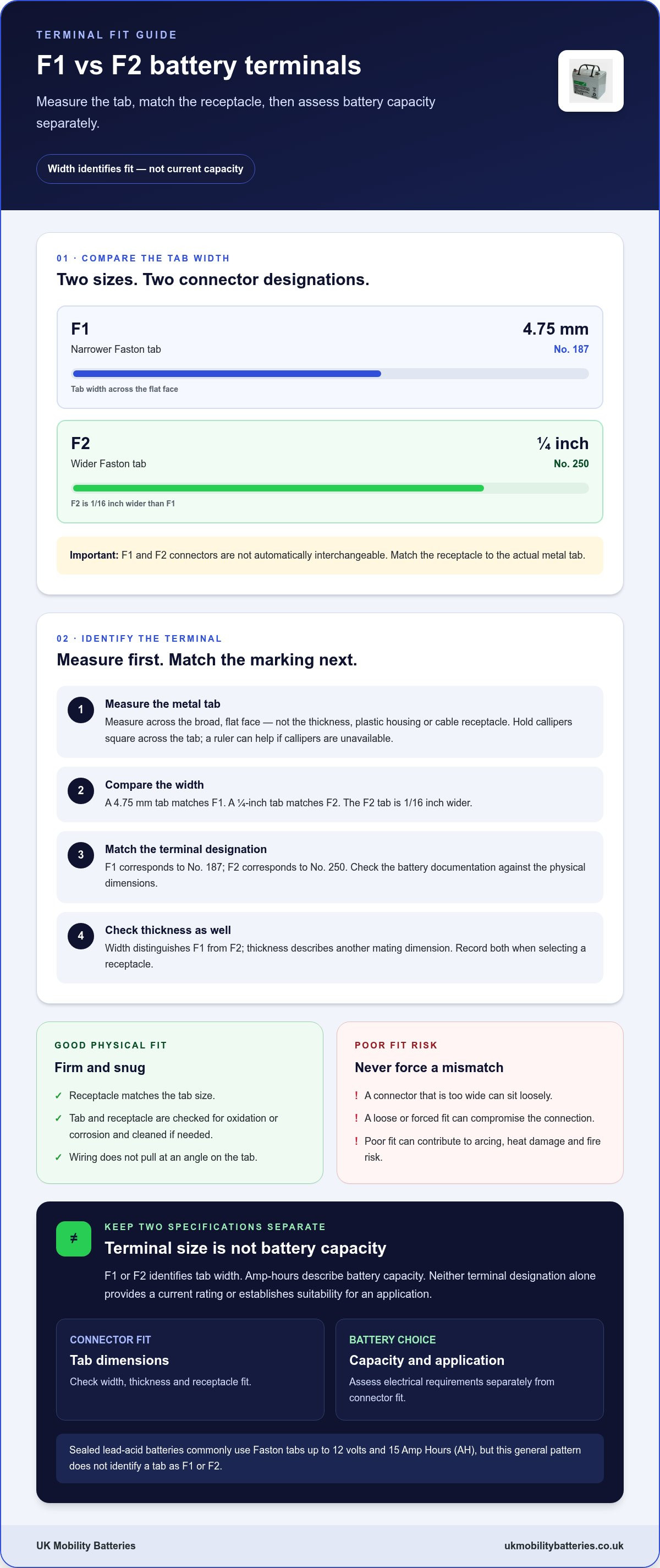
Choosing between F1 and F2 battery terminals comes down first to width: F1 is 4.75 mm wide and designated No. 187, while F2 is 1/4 inch wide and designated No. 250. The F2 tab is 1/16 inch wider, so an F1 and F2 connector aren’t automatically interchangeable. The difference between F2 vs F1 battery terminals is a useful starting point, but terminal width alone doesn’t tell you a battery’s current capacity.
If the terminals look nearly identical, it’s easy to assume the same push-on connector will fit both. In practice, a connector that’s too wide can sit loosely, whilst forcing a mismatched fit can compromise the connection.
This guide explains the terminal widths, names and dimensions, and how to distinguish current capacity from connector size. It also covers how to identify the right receptacle, when an adapter may help, and what a secure fit looks like. You’ll have a clearer basis for matching the battery terminal to its connector.
Key Takeaways
- Identify the tab by its width: F1 is 4.75 mm, while F2 is 1/4 inch wide and 1/16 inch wider.
- Use the No. 187 and No. 250 designations to distinguish F1 and F2 when matching connector types.
- Keep terminal size separate from battery capacity: connector width identifies fit, not the battery’s current capacity.
- A loose or forced connector can compromise the connection; an F1-to-F2 adapter may help when the cable connector and battery tab differ.
- Compare both terminal dimensions and battery requirements when selecting a replacement, rather than relying on appearance alone.
Terminal width and current capacity
F1 and F2 identify Faston tab widths, not a battery’s amp-hour capacity or a complete current rating. Match the connector to the physical tab, then assess the battery’s capacity and application separately.
Measuring battery terminal width
Terminal width is the measurement across the broad, flat face of the metal tab, rather than its thickness. Measure the tab itself with callipers, holding the jaws square across its width; a ruler can help if callipers aren’t available. Record width and thickness separately, since a 4.75 mm-wide tab and a 0.8 mm-thick tab describe different dimensions. Accurate measurements help distinguish close-fitting connector sizes.
F1 and F2 Faston tab widths
An F1 Faston tab is 4.75 mm wide, while an F2 tab is 1/4 inch wide, making F2 1/16 inch wider. F1 is designated No. 187 and F2 No. 250. These figures identify the connector size, not the battery’s current capacity. Sealed lead-acid batteries commonly use Faston tabs up to 12 volts and 15 Amp Hours (AH), but that general pattern doesn’t identify a tab as F1 or F2 by itself.
F1 terminals suit batteries with the narrower F1 tab and a matching receptacle. F2 terminals suit batteries specified with the wider F2 tab and its matching receptacle. In both cases, use the battery’s terminal dimensions to determine fit, rather than assuming its application or capacity identifies its connector.
Risks of the wrong terminal size
The wrong size can leave a connector loose or make it impossible to fit correctly. A T2 female connector on a T1 male terminal can sit loosely and create a poor, high-resistance connection. Don’t force a larger female connector onto a smaller male tab, or force the reverse combination; a poor fit can contribute to arcing, heat damage and fire risk.
Before connecting, inspect the battery tab and wire receptacle for oxidation or corrosion, and clean them if needed. The connector should fit firmly and snugly. Wiring should not pull at an angle on the tab, as strain can weaken the connection over time. These checks help establish a sound physical connection, but they don’t determine the battery’s current rating.
Capacity and terminal size answer different questions. Amp-hours describe battery capacity, whereas F1 or F2 identifies the tab width; neither designation alone provides a current rating. The battery’s design and intended load determine the electrical requirements, so don’t select a battery based only on whether its connector fits. For example, a 12 V sealed lead-acid battery with Faston tabs still needs a connector that matches its actual tab dimensions.
When comparing F2 vs F1 battery terminals, treat the width as a fit specification and capacity as a separate battery specification. Check the flat tab width, thickness and receptacle fit before connecting, then consider the battery’s capacity and application independently.
F1 and F2 terminal naming
F1 and F2 are Faston terminal size designations, not battery capacity ratings. Identify the type by matching its No. 187 or No. 250 designation to the terminal width and connector.
What F1 and F2 terminals are
F1 and F2 are flat Faston battery tabs designed to connect with push-on spade inserts. Their names distinguish two terminal sizes, helping you select a receptacle that fits the battery tab. F1 corresponds to No. 187, and F2 corresponds to No. 250. These numbers describe terminal size, not voltage, amp-hours or current capacity.
The distinction matters because a receptacle is sized to grip a particular tab. A connector intended for No. 250 won’t necessarily make a secure connection to No. 187. Treat the designation as a physical fit category, then assess the battery’s electrical specifications separately.
Identifying F1 and F2 terminals
To identify an F1 or F2 battery terminal, inspect the tab and measure its width across the flat face. F1 is 4.75 mm wide and designated No. 187; F2 is 1/4 inch wide and designated No. 250. The F2 tab is 1/16 inch wider than F1.
A practical identification check combines the measurement with the connector marking. For example, a measured 4.75 mm tab matches the F1 size designation, whilst a 1/4 inch tab matches F2. Measure the tab itself rather than the plastic housing or the cable receptacle. If the battery documentation gives a terminal designation, compare it with the physical dimensions.
For blade, spade or tab terminals, specify both width and thickness when selecting the mating receptacle. Width distinguishes F1 from F2, while thickness helps describe the tab’s other mating dimension. A width measurement alone may not give the complete connector specification. Keep the measurement and the F1 or F2 designation together when comparing parts.
The naming helps prevent confusion with battery capacity. A battery’s amp-hour figure describes capacity, whereas No. 187 and No. 250 identify terminal sizes. For example, seeing a capacity figure on a battery label won’t establish whether its tabs are F1 or F2. Likewise, an F2 designation doesn’t tell you the battery’s capacity or its suitability for a particular application.
Use this order when the label and appearance don’t make the terminal type clear:
- Measure the metal tab’s width across its flat face.
- Compare the result with 4.75 mm for F1 or 1/4 inch for F2.
- Match the corresponding No. 187 or No. 250 connector designation.
- Check the tab thickness as well as width before choosing a receptacle.
This method identifies the terminal by measurement rather than guessing from battery size or capacity. A matching designation and measured tab help narrow down the connector choice; the finished connection still needs to fit snugly.
F1 terminal dimensions
An F1 terminal is identified by its 4.75 mm tab width and No. 187 designation. Those dimensions help distinguish the tab from an F2 terminal and select a compatible receptacle. Width is only one part of the measurement: thickness also affects how the connector fits over the metal tab.
For blade, spade and tab terminals, specify both width and thickness. The three batteries discussed in the comparison have terminals measuring 4.75 x 0.8 mm. That measurement gives the width first and thickness second, making it more useful than describing a terminal as simply “small” or “narrow”.
To assess an F1 terminal, measure across the broad, flat face of its tab. Keep the measuring tool square to the metal, rather than measuring diagonally or including the surrounding battery casing. A diagonal measurement can overstate the width, whilst including the casing doesn’t measure the connector surface.
Then measure the tab’s thickness separately. A terminal listed as 4.75 x 0.8 mm has a width of 4.75 mm and a thickness of 0.8 mm. Recording both dimensions helps distinguish a suitable receptacle from one that matches the width but doesn’t fit the tab thickness properly.
The No. 187 designation gives another way to recognise F1 sizing. It’s a terminal-size identifier, not a voltage or amp-hour figure. For example, a receptacle marked for No. 187 is intended to mate with the corresponding F1-sized tab. The identifier helps when product descriptions use a standard number instead of the F1 name.
Measurements also explain why appearance alone can mislead. A flat tab may look close to another size, but the connector’s contact area depends on the actual mating dimensions. Use callipers where possible for a direct reading; otherwise, a ruler can help compare the tab against the 4.75 mm width. Record the result before selecting the connector.
Keep the measurement in the same order each time: width, then thickness. For a 4.75 x 0.8 mm tab, the first figure indicates the F1-width dimension, while the second describes the tab’s thickness. This avoids swapping the two values when comparing a battery label with a receptacle specification.
When a connector is too loose, its internal opening may not grip the tab securely; a connector that’s too tight may resist fitting. Match the receptacle to the measured width and thickness rather than modifying the tab to suit it. A snug fit depends on the mating dimensions, not on the No. 187 label alone.
For a clear specification, record “F1, No. 187, 4.75 x 0.8 mm” when those dimensions apply. That combines the terminal family, size designation, width and thickness in one description. It gives a practical reference when comparing the battery terminal with a replacement wire receptacle.
F1-to-F2 terminal adapters
An adapter can bridge a mismatch between an F1 battery tab and an F2 connector. It changes the mating interface, not the battery’s terminal size or electrical capacity.
How do you safely connect or replace F1 and F2 battery terminals? Use a suitable adapter when an F1 tab must connect with an F2 receptacle, rather than forcing incompatible parts together. Before connection, clean corrosion from the battery terminal and wire connector, then make sure the fit is firm and snug.
An F1-to-F2 adapter attaches to an F1 terminal and provides compatibility with an F2 connector. This can be useful when the existing cable has an F2 receptacle but the battery has an F1 tab. The adapter addresses that difference in connector fit; it doesn’t turn the battery itself into an F2-terminal battery.
Choose an adapter designed for the direction of the mismatch. An F1-to-F2 adapter is intended to connect an F1 Faston terminal with an F2-style connector. It isn’t a general solution for every terminal or wire combination. Compare the adapter’s connection sides with the battery tab and cable receptacle before fitting it.
A direct fit is preferable when the battery tab and cable receptacle match. If they don’t, an adapter can avoid forcing an oversized female connector onto a smaller male tab. The reverse mismatch is also unsuitable: don’t force a larger female connector onto a smaller male terminal, or a smaller female connector onto a larger male terminal.
Keep the connection mechanically stable after fitting. The adapter and receptacle should sit firmly without rocking or pulling away from the tab. Route the wire so it doesn’t pull at an angle on the terminal, as angled strain can weaken the connection over time. A loose fit can create a poor, high-resistance connection.
Before connecting, inspect the battery terminal and wire receptacle for oxidation or corrosion. Clean affected contact surfaces, then check that the assembled connection is snug. A firm fit helps avoid arcing, heat damage and fire risk. Don’t use an adapter to compensate for corrosion, a loose receptacle or damaged wiring.
- Match the adapter’s battery side to the F1 tab.
- Match its other side to the F2 receptacle.
- Keep the wire aligned without pulling it at an angle.
- Check for clean contact surfaces and a firm, snug fit.
These checks help distinguish a genuine size mismatch from a poor connection caused by corrosion or strain. If the original cable already has an F1 receptacle, an F2 adapter may be unnecessary; the receptacle and tab are already intended to mate by size.
An adapter changes connector compatibility only. It doesn’t change the battery’s voltage, capacity or intended application, so those specifications remain separate selection criteria. For an F1 tab and F2 cable connector, the practical choice is a correctly matched adapter or a correctly sized replacement receptacle, never a forced fit.
What are F1 and F2 battery terminals?
F1 and F2 are sizes of flat Faston tabs fitted to a battery, not battery chemistries or capacity classes. Each tab connects to a push-on spade insert, creating the contact between the battery and its wire. The distinction matters because the receptacle must match the tab’s dimensions to make a firm connection.
Sealed lead-acid batteries commonly use Faston tabs up to 12 volts and 15 Amp Hours (AH). That describes a common application, not a rule for identifying every F1 or F2 battery. Terminal type is a separate specification, so a battery’s voltage or amp-hour figure doesn’t by itself tell you which connector size it has.
The size codes provide a standard way to describe the terminal interface. F1 is designated No. 187, and F2 is designated No. 250. Those identifiers refer to terminal size, rather than a current rating. A No. 187 tab and a No. 250 tab therefore need receptacles suited to their respective dimensions.
The tab is the male contact on the battery; the wire usually ends in a female crimp receptacle. The receptacle pushes over the flat metal blade. The crimp end grips the wire, while the other end grips the tab. For example, a connector can be described by both its tab width and the wire diameter it must crimp onto.
F1 and F2 identify the mechanical mating size, not the amount of electrical energy stored. Amp-hours describe battery capacity, while a terminal designation describes the tab and matching connector. A battery marked 12 V still requires its own capacity and application to be considered separately from whether its terminal is F1 or F2.
For identification, combine the size code with the tab’s dimensions instead of relying on appearance. F1 is 4.75 mm wide; F2 is 1/4 inch wide, or 1/16 inch wider than F1. Blade, spade and tab terminals should be specified by width and thickness, since both measurements describe the mating interface.
- F1 means a Faston tab designated No. 187.
- F2 means a Faston tab designated No. 250.
- Both styles use push-on spade inserts.
- Battery capacity and terminal size describe different specifications.
A connector mismatch can affect the contact: a T2 female connector on a T1 male terminal can sit loosely and create a poor, high-resistance connection. The designation helps distinguish terminal sizes before fitting, but a secure connection also depends on a snug match between the receptacle and tab.
Use the F1 or F2 code to identify the connector family, then consider the battery’s voltage, capacity and application as separate requirements. This keeps the terminal fit specification distinct from the battery’s electrical characteristics.
UK Mobility Batteries: Lucas 12V 7Ah Sealed AGM Batteries
UK Mobility Batteries offers sealed AGM batteries for mobility scooters and wheelchairs, including Lucas 12V 7Ah Sealed AGM Batteries. Once you’ve identified the required terminal fit, match the replacement battery to your equipment’s voltage, capacity and application. Terminal size alone doesn’t determine whether a battery is suitable.
Other options include the Lucas 12V 9Ah Uprated Sealed AGM Battery, Lucas 12V 34Ah Sealed AGM Deep Cycle Battery and Lucas 12V 20Ah Mobility Battery. Compare the battery specifications with your equipment requirements, keeping connector fit and capacity as separate considerations.
For a mobility battery suited to your requirements, visit UK Mobility Batteries.
Make your next battery choice with confidence
Once you’ve compared F2 vs F1 battery terminals, treat connector compatibility as one part of the replacement decision, not the whole decision. The next step is to match the battery to the requirements of your mobility equipment and consider how its terminals connect to the existing wiring. A clear match between the battery, equipment and connection helps you move forward with a more informed choice.
If you’re choosing a replacement battery for a mobility scooter or wheelchair, UK Mobility Batteries offers sealed AGM options, including Lucas batteries. Browse the range to find an option that suits your equipment’s requirements.
Contact UK Mobility Batteries for help with your battery choice. With the relevant requirements in hand, you can take the next step towards a suitable replacement.
Frequently Asked Questions
What is the difference between the terminal type F1 and F2?
F1 and F2 are different sizes of Faston battery tab, each designed for a matching push-on spade insert. F1 is designated No. 187, while F2 is No. 250. The size code helps identify the connector family; it doesn’t indicate battery capacity. For a replacement, compare the battery’s terminal type with the existing cable receptacle before connecting them.
What is the difference between F1 and F2 terminal dimensions in mm?
F1 is 4.75 mm wide. F2 is 1/4 inch wide, equivalent to 6.35 mm, so it is wider than F1. Compare width across the flat face of the tab, and keep thickness as a separate measurement. For example, a terminal described as 4.75 x 0.8 mm has a 4.75 mm width and a 0.8 mm thickness.
Are F1 and F2 battery terminals interchangeable?
No, not as a direct push-on connection: the different widths can prevent a secure fit. A larger female connector on a smaller male terminal may sit loosely, whilst forcing mismatched parts can damage the connection. For example, a T2 female connector fitted to a T1 male terminal can create a poor, high-resistance connection. Use a matching connector or a suitable adapter.
Can F1 terminals be adapted to fit F2 connectors, or vice versa?
An adapter can connect an F1 terminal with an F2 connector, but it must be designed for that direction and fit. An adapter is not a reason to force incompatible parts together. Check that the assembled connection is snug, the contact surfaces are clean, and the wiring doesn’t pull the terminal at an angle. These checks help maintain a sound connection.
Which battery types and applications use F1 terminals?
F1 terminals are used on batteries specified with a 4.75 mm-wide tab and a matching No. 187 receptacle; the battery’s application or capacity alone does not identify the terminal size.
Which battery types and applications use F2 terminals?
F2 terminals are used on batteries specified with a 1/4-inch-wide tab and a matching No. 250 receptacle; the battery’s application or capacity alone does not identify the terminal size.