
Energy Saving Tips for Mobility Scooter Users
What if a few changes to how you ride and plan could help you make better use of your scooter’s available range? It’s understandable to wonder whether everyday habits are using more battery than necessary, especially if you’re unsure whether there’ll be enough charge for the return journey. These energy saving tips for mobility scooter users focus on practical decisions, not quick fixes.
Journey length, route and riding conditions can all affect how much charge remains. Battery condition matters too: efficient use can reduce avoidable demand, but it can’t restore capacity lost through deterioration.
This guide explains how to ride smoothly, choose realistic routes and set sensible range expectations before setting off. It also covers how battery selection relates to your scooter’s requirements, and what reduced range may indicate if it continues despite changes to your routine. Check your scooter manufacturer’s guidance for model-specific riding, charging and battery advice. A few straightforward checks can help you plan outings with more confidence and distinguish everyday energy use from a possible battery issue.
Key Takeaways
- Learn which riding conditions and journey factors affect the charge your scooter uses.
- Use these energy saving tips for mobility scooter users to make everyday journeys more efficient without compromising safe riding.
- Compare route options by surface and slope, while keeping accessibility and comfort in mind.
- Follow a simple before, during and after journey routine to plan ahead and notice changes in battery use.
- Understand why gradual range loss may differ from a sudden change that needs investigation.
Where Does a Mobility Scooter Use Energy? Understand the Main Factors
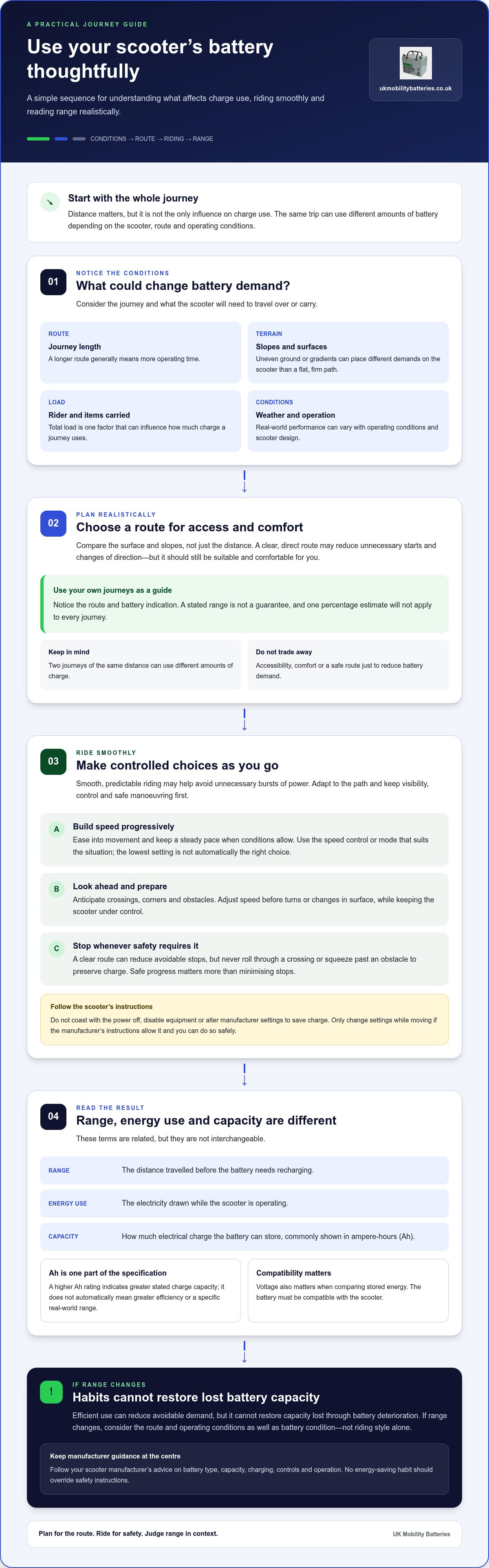
A mobility scooter draws electricity from its battery whenever it operates. How much charge a journey uses depends on more than distance: the scooter’s design, battery condition, route and operating conditions all play a part. The same trip can therefore use different amounts of battery on different days, or on different scooters.
Understanding these variables makes energy saving tips for mobility scooter users more useful. It helps you assess a change in range without assuming that riding style is the only cause. For a general explanation of scooter types and battery-powered operation, see the Mobility Scooter Overview.
What changes how much battery a journey uses?
Terrain, surface, total load and journey length all influence battery demand. A longer route generally requires more operating time, while a slope or uneven surface can place different demands on the scooter than a flat, firm path. Total load includes the rider and anything carried. The effect of each factor varies with the scooter and route, so a single percentage estimate won’t apply to every journey.
Think about a trip that includes smooth paths and rougher sections. Distance alone won’t tell you how much charge it will use: surface and gradients matter too. Weather and other operating conditions can also affect real-world performance. Use your own journeys as a guide by noting the route and battery indication, rather than treating a stated range as a guarantee.
Range, battery capacity and energy use are not the same
Range is the distance a scooter travels before its battery needs recharging. Energy use is the electricity drawn during operation. Capacity describes how much electrical charge a battery can store, commonly shown in ampere-hours (Ah). The terms are related, but they aren’t interchangeable: range depends on capacity as well as the scooter and conditions of use.
A higher Ah rating indicates greater stated charge capacity, not automatically greater efficiency or a specific real-world range. Voltage also matters when comparing stored energy, and the battery must be compatible with the scooter. Two journeys of the same distance could use different amounts of charge if one includes more slopes, a heavier load or a less favourable surface.
When comparing replacement options, treat the Ah figure as one part of the specification, not a prediction of range. Follow the scooter manufacturer’s guidance on battery type, capacity, charging and operation. No energy-saving habit should override safety instructions: don’t take an unsuitable route or change how you use the scooter to reduce battery demand. The aim is to use charge thoughtfully within the scooter’s operating requirements.
How to Ride a Mobility Scooter Efficiently Without Sacrificing Safety
Smooth, predictable riding can help avoid unnecessary bursts of power. Accelerate progressively, let the scooter build speed under control, and maintain a steady pace when conditions allow. These habits may reduce avoidable battery demand, but they’re never a reason to compromise visibility, control or safe manoeuvring.
Good energy saving tips for mobility scooter users start with adapting to the route, not chasing the lowest possible energy use. A busy path, poor visibility or tight turn may call for a different speed or manoeuvre than a clear, open stretch. Follow the scooter’s operating instructions and choose a pace that lets you respond safely.
Use acceleration and speed settings deliberately
Repeatedly accelerating sharply from a standstill can create unnecessary bursts of demand. Where the path is clear, build speed smoothly and keep your progress steady rather than rushing between stops. Use the speed control or mode that suits the conditions. The lowest setting isn’t automatically the most appropriate if it affects your ability to travel safely. Your scooter manual explains how to use its controls and speed modes.
- Ease into movement instead of applying the control abruptly.
- Adjust speed before a turn, crossing or change in surface, while keeping the scooter under control.
- Avoid changing settings while moving unless the manufacturer’s instructions allow it and you can do so safely.
Don’t coast with the power off, disable equipment or alter manufacturer settings to save charge. These actions may affect safe operation. Follow the manual, and prioritise clear visibility and predictable control over small potential energy savings.
Reduce avoidable stops and manoeuvres
Look ahead and anticipate crossings, corners and obstacles. A clear, direct route can reduce unnecessary starts, stops and repeated changes of direction. For example, if you can see a turn approaching, prepare for it early and take it at a controlled speed instead of making a sudden correction at the last moment.
That doesn’t mean rolling through a crossing, squeezing past an obstacle or choosing a less accessible route to preserve battery. Stop whenever safety requires it, and manoeuvre at a pace that gives you time and space to stay in control. Safe progress matters more than minimising stops.
On familiar routes, notice where you usually need to pause or turn. Then consider whether a clearer alternative is available without sacrificing comfort or access. Smooth riding habits can support more efficient use, but they can’t restore capacity lost as a battery deteriorates. Mobility Plus discusses usage habits and other battery-life factors in its Mobility Scooter Battery Lifespan and Care guide. If reduced range points to a battery-related concern, read about mobility scooter battery options.
How Route, Terrain and Scooter Setup Affect Travel Range
Route conditions affect how much work a scooter must do. A flat, firm path is generally less demanding than a longer journey with uneven ground or sustained inclines, but the effect depends on the scooter, its condition and the whole route. There’s no universal range adjustment for every model. Avoid unnecessary demands where you can, while keeping accessibility, comfort and safe travel at the centre of your decision.
Choose a suitable route before setting off
Compare the whole journey, including the return, rather than choosing by distance alone. A slightly longer route with a firm surface, manageable gradients and accessible crossings may be more practical than a shorter route with steep sections or difficult ground. Allow for stops and leave a suitable reserve, guided by your experience with the scooter and the manufacturer’s range guidance.
Before setting off, consider the route’s surface, inclines, crossing points and any sections that may be difficult to navigate. This comparison can help you weigh up your options.
| Route or setup factor | Likely effect | Practical response |
|---|---|---|
| Flat, firm surface | May place fewer demands on the scooter than uneven ground or slopes. | Use it where it’s accessible and comfortable. |
| Longer, uneven or sloping route | May use more charge, depending on the scooter and conditions. | Consider an accessible alternative and plan for the return. |
| Visible tyre wear or damage | May affect how the scooter travels and could signal a condition to investigate. | Follow the manual’s inspection guidance; don’t attempt unauthorised adjustments. |
| Load carried | Can influence the demands placed on the scooter. | Carry what you need and stay within manufacturer guidance. |
Check scooter condition without attempting unauthorised adjustments
Before setting off, look for visible changes in tyre condition and note anything unusual in the scooter’s performance. Use the manufacturer’s manual for routine checks and approved setup. Don’t change settings, alter components or attempt repairs based on battery-saving advice. Setup requirements differ by model, so follow the instructions for your scooter.
If a familiar route suddenly uses noticeably more charge, or range changes unexpectedly, record what’s different about the journey and the scooter’s behaviour. A route change may explain gradual variation, but a sudden shift deserves attention rather than guesswork. The guide to mobility scooter battery troubleshooting explains possible signs of a battery-related issue.
These energy saving tips for mobility scooter users are planning tools, not a reason to take a less accessible route or adjust equipment without guidance. Choose a journey that suits your needs, the scooter and the conditions, then use what you observe to inform future plans.
A Simple Before, During and After Journey Energy-Saving Routine
A repeatable routine helps you compare journeys and spot patterns without specialist equipment. A notebook or phone note is enough. Record the route, conditions and battery indication before and after an outing. Compare several similar journeys rather than drawing conclusions from one trip, to build a more useful picture of typical energy use.
Before the journey: plan distance and conditions
Plan the whole outing, not just the distance to your destination. Include the return journey, likely stops and a suitable reserve. Check the route for surface changes, inclines, accessible crossings and alternatives. Then consider whether the expected load or conditions differ from a familiar trip. Follow the scooter manual for model-specific pre-journey checks and battery guidance.
- Estimate the outward and return distance.
- Note slopes, uneven sections and accessible alternatives.
- Consider what you’ll carry and whether the route is comfortable for you.
- Check the manual for any checks or instructions that apply to your scooter.
A shorter route isn’t always the best option if it includes difficult ground or a steep section. Choose a practical route you can complete safely, with a reserve informed by your scooter’s observed performance. Don’t rely on a single stated range figure as a guarantee for every journey.
During and after the journey: notice useful patterns
Ride consistently and safely, and avoid unnecessary detours where practical. Don’t skip a necessary stop or take a less accessible path to conserve charge. After the trip, note the battery indication and any unusual change in performance alongside the route conditions. This makes it easier to see whether a difference recurs in similar circumstances.
- Record the route and approximate distance.
- Note surface, inclines, load and weather conditions.
- Write down the battery indication before and after the journey.
- Mark any unexpected change, then compare it with later trips.
Keep the record simple. If a journey uses more charge than usual, note whether the route was longer, wetter, rougher or included more slopes. A pattern across repeated outings is more informative than one unusual reading. If the change is sudden or continues in similar conditions, use the manufacturer’s guidance to decide what to investigate next.
Follow the scooter and battery manufacturer’s instructions for charging and storage. Keeping these habits consistent makes your journey comparisons more useful. For broader guidance on mobility scooter battery care and maintenance, refer to the dedicated battery-care guide.
These energy saving tips for mobility scooter users work best as a routine: plan, ride safely, then record what happened. If your observations point to a battery-related concern, read about mobility scooter battery options.
When Battery Condition Matters More Than Energy-Saving Habits
Smoother riding and careful route planning can reduce avoidable battery demand, but they can’t restore capacity lost through battery deterioration. If your scooter covers less distance than it used to, your habits may not be the cause. Compare journeys under broadly similar conditions to judge whether the change is gradual or unusual.
A steady reduction over time can suggest that the battery’s available capacity has declined. A sudden drop, or a marked change between otherwise similar outings, needs investigation rather than simply trying harder to save charge. Other factors can affect performance too, so don’t assume a replacement battery is automatically the answer.
When to investigate a change in battery performance
Keep brief records of journey distance, route conditions and battery indication. If range continues to fall across repeated, comparable trips, or changes unexpectedly, use the scooter manual for guidance and investigate the scooter and battery. The mobility scooter battery troubleshooting guide outlines possible warning signs and next steps.
Choosing a compatible replacement battery
Use the scooter manual or existing battery specification as your starting point. Voltage, physical dimensions, terminal type and capacity must suit the scooter. Matching only one detail, such as the Ah rating, isn’t enough. Follow the manufacturer’s requirements for battery type and installation. If the existing specification is unclear, don’t guess or alter the scooter to make a battery fit.
Sealed AGM batteries and Lucas batteries are options in the mobility battery category, but suitability depends on the individual scooter’s requirements. A different battery does not guarantee a longer range or make the scooter use less energy. Battery condition, compatibility and the demands of your journeys all matter.
Use energy saving tips for mobility scooter users to manage avoidable demand, then treat a persistent or abrupt range change as a separate issue to assess. This distinction helps prevent inefficient riding habits from being confused with reduced battery capacity, and avoids expecting riding changes to fix a battery-related problem.
If you’re assessing a possible replacement, use the scooter’s stated requirements to narrow the choice and read about mobility scooter batteries.
Make your next battery decision with confidence
If a change in range persists, compare your observations with the scooter’s battery requirements before deciding what to do. Efficient habits can help manage energy use, but they can’t recover capacity lost through battery deterioration. A compatible replacement should match the scooter’s specifications, not simply the range you hope to achieve.
Keep your journey notes alongside the battery details in your manual. This gives you a useful reference if you need to consider battery options. UK Mobility Batteries sells sealed AGM batteries in capacities from 7Ah to 150Ah, including Lucas options for mobility scooters and wheelchairs, with UK-wide delivery and expert technical support.
Explore mobility scooter batteries and use the manufacturer’s specifications as your starting point. A considered match is a more dependable next step than expecting a new battery alone to guarantee greater range.
Frequently Asked Questions
How much electricity does a mobility scooter use per full charge?
There isn’t one fixed amount. It depends on battery capacity, how depleted it is and energy lost during charging. For a nominal estimate, multiply battery voltage by its ampere-hour (Ah) rating to get watt-hours, then divide by 1,000 for kilowatt-hours. For example, a hypothetical 24 V, 20 Ah battery has a nominal capacity of 0.48 kWh. This isn’t a precise measure of electricity drawn from the mains, because charging losses and actual battery condition affect the result.
Is it better to charge a mobility scooter after every journey?
Follow the charging routine specified for your scooter and battery, as there’s no single rule for every model. Check the manual for advice on charge level and what to do if the scooter won’t be used for a while. Don’t deliberately run the battery very low just to charge less often. Consistent, manufacturer-approved charging is more useful than trying to minimise charging frequency through energy saving tips for mobility scooter users.
Can I use a car battery charger for a mobility scooter?
Only use a charger specified as compatible with your scooter’s battery and charging requirements. A car charger isn’t automatically suitable: voltage, battery chemistry and charging method all matter. Using an incompatible charger may affect charging or damage the battery. Check the scooter manual and charger specifications before connecting it. If the recommended charger is unavailable, don’t substitute another based only on a matching plug or voltage.
Does leaving a mobility scooter switched on while parked drain the battery?
It may use some power, although the amount depends on the scooter’s controls and electrical systems. If you’re waiting for a short time, follow the manual’s instructions on whether to switch off. For a longer stop, switching off may avoid unnecessary power draw if the manufacturer advises it. Park safely and don’t leave the scooter unattended in a way that could create a hazard.
Will taking the shortest route always save mobility scooter battery?
No. A shorter journey may include steep gradients, rough ground or difficult crossings, while a longer alternative may offer a smoother, more accessible path. Compare the whole trip, including the return, and consider where you can travel comfortably and safely. For example, a route with a gentler incline may be more practical than a direct route with a demanding slope. Don’t trade safe access for fewer metres travelled.
Why does my mobility scooter’s range vary from one journey to another?
Differences in route, load, surface and riding conditions can change how much charge a journey uses. Battery condition or a change in scooter setup may also affect performance. To look for a pattern, compare the battery indication before and after several similar trips, noting what differed. One unusual journey may not indicate a fault. If range drops suddenly or remains unusually low, investigate the scooter and battery rather than assuming riding habits are the only cause.
For help choosing a battery to match your scooter’s specifications, explore UK Mobility Batteries’ mobility scooter batteries.