
Conditioning a New Deep Cycle Battery: Before First Use
A new deep-cycle battery doesn’t automatically need repeated full discharges before use. Conditioning a new deep cycle battery is often described as a special break-in routine, but the right first steps depend on its chemistry and the manufacturer’s instructions.
Before connecting a charger, check the battery’s first-use guidance. Some manufacturers recommend a full charge before use, while advice about cycling and discharge varies. For a sealed AGM battery, use a compatible charger and follow the battery’s charging guidance. Its sealed construction means it doesn’t need watering, but correct charging still matters.
This guide explains what conditioning does and doesn’t mean, how to prepare a new battery safely, and why repeated cycles or full discharges aren’t a universal requirement. You’ll also learn which first-use practices apply to sealed AGM batteries, what to avoid, and when model-specific instructions take precedence over general advice.
Key Takeaways
- Conditioning a new deep cycle battery means preparing it for service, not automatically putting it through repeated charge-and-discharge cycles.
- Identify the battery chemistry and nominal voltage before charging, then match the charger to the manufacturer’s instructions.
- Sealed AGM batteries use VRLA construction and don’t need watering, unlike flooded lead-acid batteries.
- Follow the specified first-charge procedure before normal use. Avoid deliberate full discharge or a fixed cycling routine unless the instructions require it.
- Use model-specific guidance for a Lucas sealed AGM mobility battery rather than assuming every battery follows the same first-use procedure.
What does conditioning a new deep-cycle battery actually mean?
Conditioning a new deep-cycle battery means preparing it for service by confirming its type, checking its condition and following the maker’s first-charge instructions. It may include a full initial charge if the manufacturer recommends one. Conditioning doesn’t automatically mean repeatedly discharging and recharging the battery.
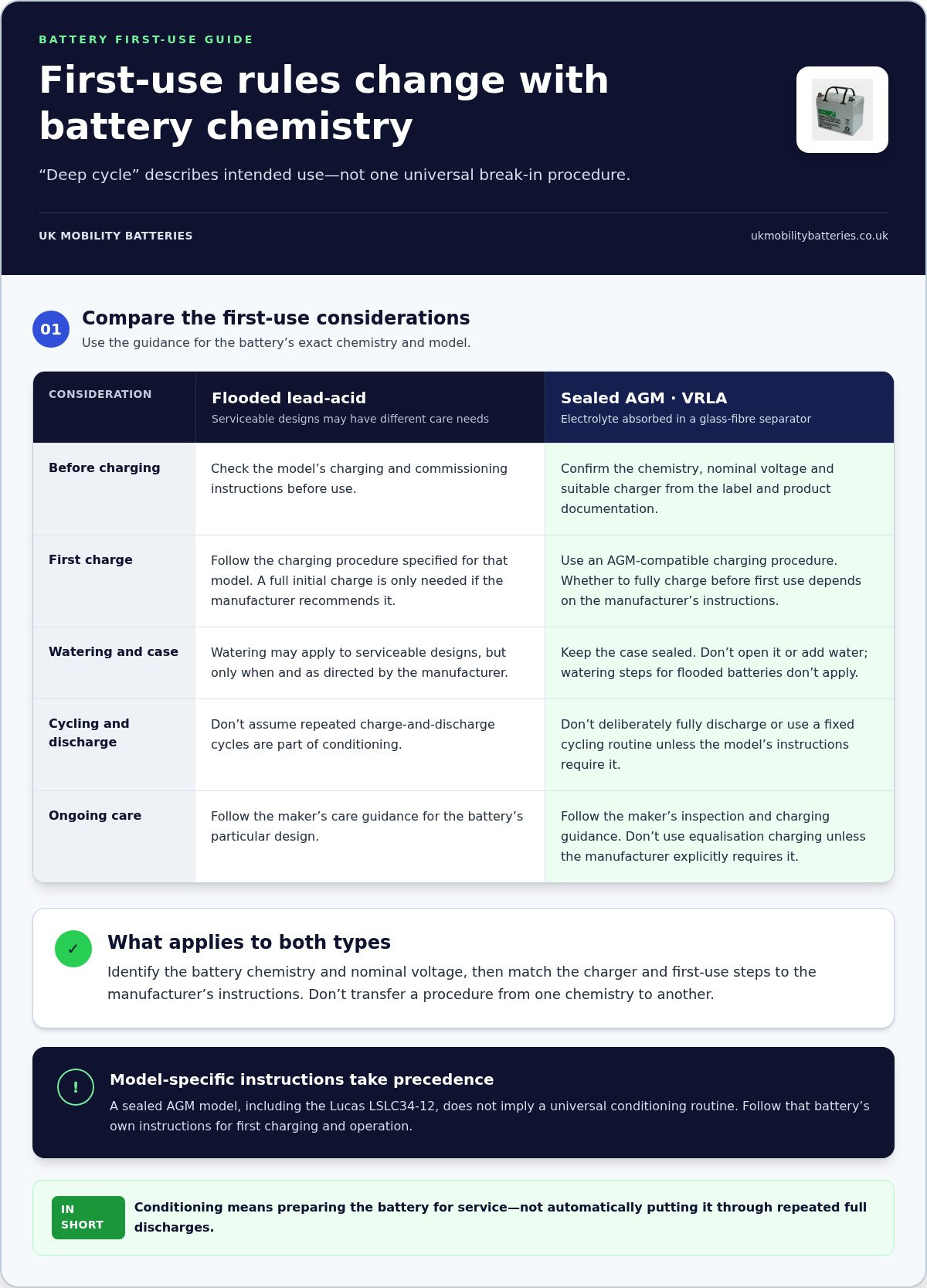
The distinction matters because “deep cycle” describes a battery’s intended use, not one universal break-in procedure. First-use advice varies by chemistry, model and manufacturer. A flooded lead-acid battery and a sealed AGM battery, for example, have different maintenance requirements. Use the instructions for the exact battery rather than applying a routine found online to every type.
In practical terms, conditioning a new deep cycle battery is commissioning: preparing it correctly before it powers equipment. That’s separate from routine maintenance, which covers care during use and storage. A full first charge may be part of commissioning, but the charging method, settings and any additional steps must come from the battery documentation.
Does a new deep-cycle battery need cycling before use?
Some manufacturers describe a battery’s available capacity as developing over its early charge-and-use cycles. That doesn’t make repeated deep discharges a standard conditioning method. Deliberately draining a new battery to “train” it could conflict with its instructions, so don’t assume it’s necessary across chemistries. If the manufacturer specifies a model-specific cycle routine, follow it. Otherwise, don’t invent a cycle count or discharge target.
Conditioning, charging and maintenance are different tasks
The initial preparation charge gets the battery ready for its first use. Later charging restores energy after use and should follow the same chemistry-appropriate guidance. Charging characteristics affect performance and lifespan; Lead-acid battery charging and lifespan provides background on the chemistry, but the battery maker’s instructions should guide the actual procedure.
Commissioning is also distinct from ongoing inspection and storage. During use, follow the manufacturer’s recommendations for checking and charging the battery. For storage, use its specific instructions rather than assuming that the first-charge procedure covers long-term care.
Maintenance advice must match the battery design. Flooded lead-acid batteries have different requirements from sealed AGM batteries. AGM batteries use absorbed electrolyte in a valve-regulated lead-acid (VRLA) construction. They’re sealed and don’t require watering, so don’t apply watering steps intended for flooded batteries to a sealed AGM model.
- Identify the battery chemistry and model before selecting a first-use procedure.
- Use a full initial charge if the manufacturer recommends one, following the specified charger guidance.
- Keep first-use charging, cycling and ongoing maintenance as separate tasks.
This approach avoids treating general advice as a product-specific instruction. If guidance conflicts, follow the instructions for the exact battery rather than a generic conditioning routine.
Why battery chemistry changes the conditioning advice
The broad term “deep-cycle” describes how a battery is designed to deliver power. It doesn’t identify its chemistry or set its first-charge procedure. Flooded lead-acid and sealed AGM batteries have different maintenance needs. When conditioning a new deep cycle battery, identify the chemistry first, then follow the instructions for its exact model.
A sealed AGM battery contains electrolyte absorbed in a glass-fibre separator and uses valve-regulated lead-acid (VRLA) construction. UK Mobility Batteries’ confirmed AGM products are maintenance-free, spill-proof and leak-proof. Those features don’t remove the need for correct charging, but they do mean flooded-battery watering instructions aren’t relevant.
| Battery type | First-use consideration | Maintenance distinction |
|---|---|---|
| Flooded lead-acid | Use the charging and commissioning steps specified for the model. | Watering may apply to serviceable designs, but only as directed by the manufacturer. |
| Sealed AGM, VRLA | Use an AGM-compatible charging procedure. Whether a full initial charge is required depends on the manufacturer. | Don’t open the case or add water. Follow the maker’s inspection and charging guidance. |
| Both types | Charger settings and any special first-use steps depend on the manufacturer. | Don’t assume that a procedure for one chemistry applies to the other. |
How should a new sealed AGM battery be treated?
Keep the case sealed. Don’t open an AGM battery or top it up with water. Check the label and product documentation to confirm its chemistry, nominal voltage and suitable charger before connecting it. Charge it fully before first use only if its instructions call for that, and use the specified method rather than copying settings from another battery.
The Lucas LSLC34-12 is an example of a sealed AGM deep-cycle battery. Its product name doesn’t indicate a universal conditioning routine. Use the manufacturer’s instructions for first charging and operation, and don’t assume the steps for another AGM model will necessarily match.
Why flooded-battery instructions may not apply to AGM
Watering guidance is for serviceable flooded batteries, not sealed AGM units. Likewise, don’t apply equalisation charging to an AGM battery unless its manufacturer explicitly requires it. An unsuitable charging mode can conflict with the battery’s specified requirements.
Read the chemistry label before acting on advice that simply says “deep-cycle battery”. If you’re considering a sealed AGM option for mobility equipment, UK Mobility Batteries’ sealed AGM battery range includes confirmed Lucas models. For whichever model you choose, its own documentation takes precedence for charger compatibility, charge settings and first-use steps.
Prepare the battery and charger before its first charge
A few checks before charging can help prevent a mismatch between the battery, equipment and charger. Start with the battery label and product documentation. Don’t rely on appearance alone: batteries with similar cases may use different chemistries or require different charging settings. These checks are an important part of conditioning a new deep cycle battery, but they don’t replace the manufacturer’s procedure.
Work through this checklist before connecting the charger:
- Identify the battery. Confirm its chemistry, nominal voltage and model from the label or documentation. Check that these match the equipment’s requirements.
- Inspect the case. Look for cracks, bulging, visible leakage or other damage. Don’t open a sealed battery to inspect its contents.
- Check the terminals and connections. Look for loose, damaged or contaminated terminals and cables. Keep metal tools and other conductive objects clear of the terminals to reduce the risk of an accidental short circuit.
- Verify the charging setup. Check the charger’s compatibility and settings against the battery maker’s guidance, and follow its directions for charging location and conditions.
Use a charger approved for the battery’s chemistry and specifications. If the label and documentation don’t establish compatibility, don’t guess at a setting or assume a charger is suitable just because its connector fits.
Check the battery label and physical condition
Match the battery’s nominal voltage to the equipment, then confirm its chemistry and model. Before charging, examine the outside and terminals without dismantling the battery. Don’t proceed with a visibly damaged case, signs of leakage or loose connections. Keep the battery stable, prevent terminals from touching conductive objects, and follow any handling precautions in its documentation.
Check the charger and charging location
Use the charger specified or approved for the battery type. Follow the manufacturer’s instructions for placement, ventilation and temperature, as these requirements can vary. Don’t assume a generic automotive charger or a setting intended for another lead-acid chemistry is suitable. Voltage settings and charge duration depend on the model, so use the figures in the relevant product documentation rather than general values.
Before switching on, check that the charger leads and connectors are in good condition and that the charging area meets the battery and charger instructions. Keep the setup away from avoidable sources of damage, and don’t leave cables where they can be pulled, crushed or caught. If the equipment’s connection instructions differ from the charger’s, follow the battery maker’s directions for the complete charging setup.
These checks apply to sealed AGM batteries as well as other chemistries, but the required charger settings differ. For a mobility battery, match the charger to the battery documentation rather than assuming all 12V models share identical charging requirements. UK Mobility Batteries’ sealed AGM mobility batteries are examples of products where chemistry and model information guide charger selection.
Follow a safe first-charge and first-use sequence
Once you’ve checked the battery, charger and connections, follow the instructions for that specific battery and charger. Conditioning a new deep cycle battery doesn’t mean deliberately draining it or repeating an arbitrary charge routine. The practical sequence is straightforward: connect as directed, complete the prescribed charge, then use the battery normally.
- Set up the connection. Follow the battery and charger instructions for connecting the leads, including the correct terminal polarity and connection order. Keep the charger switched off until connections are secure if its instructions specify this.
- Charge as directed. Select only the charging mode specified for the battery chemistry and model. Follow the charger’s guidance on how to recognise charge completion.
- Disconnect as instructed. Once the charger indicates the charge is complete, follow its directions for disconnecting the leads. Don’t assume every charger uses the same indicator or shutdown process.
- Begin normal use. Put the battery into service according to the equipment instructions. Recharge it in line with the battery maker’s guidance after use.
What to do during the initial charge
Follow the order and conditions set out in the battery and charger documentation. Charge completion may be shown by an indicator or another method, but the signal and expected charging time depend on the equipment. Don’t apply a universal overnight-charging rule. If the battery, cable or charger becomes damaged or behaves abnormally, stop the process and follow the manufacturer’s safety guidance.
Pay attention to the charger’s instructions rather than relying on a guessed duration. Charging care after the first use matters too; the mobility scooter battery overcharging guide covers that separate topic in more detail.
How to approach the first discharge and recharge
Use the battery for its intended purpose instead of creating extra deep-discharge cycles to “condition” it. Some manufacturers provide model-specific capacity-development or cycling advice, but it isn’t a universal instruction. Cycle limits and the point at which to recharge depend on the battery. Follow its documentation rather than applying one depth-of-discharge figure across different chemistries.
During early use, pay attention to the equipment’s behaviour and the battery’s instructions. If the maker specifies a particular first-use routine, follow it. Otherwise, use the battery normally and charge it as directed rather than inventing a full-discharge test or fixed cycle count. This keeps everyday use separate from a special commissioning procedure.
For a mobility setup, choose a battery that matches the equipment and follow its charging guidance from the first connection onwards. Browse sealed AGM battery options for mobility equipment.
Choose a compatible sealed AGM battery and use its own instructions
The right first-use procedure starts with choosing a battery that matches the equipment. Before buying or charging, confirm the chemistry, voltage and manufacturer’s instructions. A battery described as deep-cycle isn’t automatically compatible with a particular mobility scooter, and the broad category doesn’t determine its charging procedure.
Use the equipment manual and battery documentation together. Check:
- Chemistry and voltage: confirm the required battery type and nominal voltage.
- Configuration: establish how many batteries the equipment uses and how they connect.
- Physical fit: compare the battery’s stated dimensions with the available space.
- Terminals: match the terminal type and connection arrangement shown in the specifications.
- Charging guidance: check that the charger is compatible with the chosen battery and follow its instructions.
Don’t treat a higher capacity as a conditioning adjustment. Capacity is part of the battery’s specification, not a first-use setting. Any change must remain compatible with the equipment and its configuration.
What to match before choosing a replacement battery
Compare the equipment manual with the exact battery specifications, including voltage, chemistry, dimensions and terminal type. A battery that fits physically may still be unsuitable if its electrical specifications or connections don’t match. The Lucas LSLC55-12 is an example of a sealed AGM mobility battery, not a recommendation to substitute it without checking the equipment requirements.
Where to find the correct first-use instructions
Use the instructions supplied for the exact battery and its compatible charger. Keep them accessible so later charging sessions follow the same model-specific guidance. For broader selection and care information, the UK mobility scooter battery guidance covers considerations for mobility equipment.
With sealed AGM batteries, maintenance-free construction means there’s no watering step, but it doesn’t replace the need to use the correct charging instructions. First-use advice should come from the maker’s documentation, not a routine applied to every deep-cycle battery. That’s the practical rule for conditioning a new deep cycle battery: match the chemistry and specifications, then follow the battery’s own procedure.
To explore sealed AGM options for mobility equipment, browse sealed AGM mobility batteries and compare their stated specifications with your equipment manual.
Choose your next battery with confidence
Before choosing a replacement, use your equipment requirements to narrow the options. Keep the selected battery’s charging instructions accessible for its first use and future charging sessions. If advice about conditioning a new deep cycle battery seems to conflict, follow the guidance for the exact model and compatible charger.
UK Mobility Batteries supplies sealed AGM and VRLA battery options for mobility equipment. Selected confirmed models state deep-cycle capability delivering up to 30% more deep cycling than standard batteries. This is a model-specific product claim, not a promise of a particular lifespan or result from a conditioning routine.
Ready to compare options against your equipment’s requirements? Browse sealed AGM mobility batteries and review their specifications before choosing. Match the battery to your equipment, then follow its instructions to prepare it for use.
Frequently Asked Questions
Can I use a car battery charger to condition a new deep-cycle battery?
Only if the charger is specifically compatible with the battery’s chemistry, voltage and charging requirements. For conditioning a new deep cycle battery, a charger’s label or general-purpose description isn’t enough to establish suitability. Check the charger and battery instructions for an approved charging mode. If the charger offers settings for different battery types, don’t select one unless the battery manufacturer permits it.
How long can a new deep-cycle battery sit unused before I charge it?
There’s no single safe storage period that applies to every deep-cycle battery. Self-discharge, storage temperature and the battery’s condition can affect how it behaves whilst unused. Follow the manufacturer’s storage and recharge guidance rather than relying on a general time limit. If the battery has been stored, consult its specified procedure before putting it into service, particularly if you don’t know its charge state.
Can I condition a new deep-cycle battery in a cold garage?
Only if the battery’s charging temperature requirements allow it. Limits vary between chemistries and models, so don’t assume that one sealed AGM battery shares another’s permitted range. Check the product documentation and follow its charging conditions. If the battery is outside the stated limits, wait until it is within the permitted range before connecting the charger rather than trying to compensate with a different setting.
Do sealed AGM deep-cycle batteries need water added before first use?
No. A sealed AGM battery isn’t designed to be opened or topped up by the user. Its electrolyte is absorbed in a glass mat, and its VRLA construction is intended to be maintenance-free. Watering instructions apply to serviceable flooded batteries, not sealed AGM models. For charging or storage, use the guidance supplied for the specific battery rather than adapting flooded-battery care steps.
Should a new deep-cycle battery be fully discharged before its first recharge?
No. Don’t deliberately discharge a new battery fully unless its manufacturer explicitly instructs you to. “Deep-cycle” describes the intended use, not a requirement to drain the battery during conditioning. Use it as directed and recharge according to its own guidance. A complete discharge may be inappropriate for the chemistry and model, so don’t use it as a test of whether the battery is ready.
Why might a new deep-cycle battery seem to have less capacity at first?
Possible factors include the battery’s state of charge, the equipment’s power demand and whether the battery matches the equipment. Some manufacturers describe capacity developing over initial cycles, but this isn’t a rule for every model. First review the charging and equipment instructions, then consider whether the load is what the battery is intended to support. Don’t add extra discharge cycles unless the manufacturer specifies them.