
Batteries for Jazzy Power Chair: How to Choose the Right Replacement in 2026
Could a battery advertised for a Jazzy chair still be the wrong replacement? The Jazzy name covers models with different battery requirements, so choosing batteries for Jazzy power chair use by name alone can lead to a mismatch. Most Jazzy chairs use a 24V system made up of two 12V batteries, but the required capacity, dimensions, terminals and battery type depend on the specific model.
It’s understandable to expect the model name to be enough. A safer approach is to compare the original battery labels and chair documentation, then check each specification before buying. This guide explains how to identify those requirements and assess whether AGM, gel or lithium is suitable for your chair, rather than assuming the battery types are interchangeable.
You’ll also learn how to compare replacement options with the chair’s documented configuration. Where specifications match, Lucas sealed AGM batteries, including 12V 34Ah and 12V 55Ah options, may be worth considering. Their VRLA construction is maintenance-free, spill-proof and leak-proof. UK Mobility Batteries is a specialist retailer of mobility and wheelchair batteries, with technical support and nationwide delivery to help you compare options.
Key Takeaways
- Identify your chair’s exact model, then use its documentation and battery labels to establish the replacement requirements.
- Compare voltage, amp-hour capacity, dimensions and terminal details before choosing batteries for Jazzy power chair use.
- Assess AGM and lithium against the chair’s documented requirements. Battery types aren’t automatically interchangeable.
- Record the battery details and verify that a replacement matches the electrical and physical specifications.
- Consider the Lucas LSLC34-12, a 12V 34Ah sealed AGM deep-cycle option, only if it matches your chair’s documented requirements.
Batteries for Jazzy power chairs: why the exact model matters
A replacement battery must match the chair’s documented electrical and physical requirements. “Jazzy” identifies a power-chair range, not one battery configuration. Different chairs can look similar but require different battery types, capacities, sizes or connections. Most Jazzy power chairs use a 24V system supplied by two 12V batteries, but this general pattern doesn’t establish the requirements of a particular model.
Start with the chair’s identification label and manual. Together, they help establish which model you own and the replacement configuration specified by the manufacturer. A general overview of electric wheelchair battery types can provide broader context, but it can’t confirm what fits your chair.
Voltage is the electrical rating, Ah capacity describes stored charge, and physical fit depends on the battery’s dimensions and connections. These are separate checks. A matching voltage alone doesn’t prove that a battery is suitable.
How to identify the Jazzy model you own
Locate the chair identification label and record the model name exactly as printed. Check the manual or other chair documentation for the same model designation and any model-specific battery information. Don’t rely on appearance or a shortened name from an advert. Similar-looking chairs may have different electrical or physical battery requirements.
Keep chair identification separate from battery identification. The chair label tells you which chair you have; the battery label tells you what is installed now. Both are useful, but compare the installed battery with the chair documentation rather than treating it as definitive on its own. If labels are hard to read, take clear photographs before searching.
Why the original battery is a useful reference
Photograph each original battery label and record its voltage, Ah rating and visible product code. If the chair uses a pair, note the information from both batteries. These details give you concrete specifications to compare with the manual and product listings. They can also reveal a difference between the battery currently fitted and the configuration the chair is designed to use.
Check the space and connections as well as the ratings. The battery tray affects whether a replacement can be positioned correctly, and the connection arrangement must suit the chair’s leads. Don’t guess dimensions or terminal details from a product image. Use the manual and original components as references.
A category listing such as “mobility battery” or “12V battery” is a starting point, not proof of fit. Compare the full documented specification: system voltage and battery count, capacity, physical dimensions, terminal details and battery type. This model-first approach helps prevent an appealing product description from being mistaken for compatibility evidence.
Which battery specifications must match a Jazzy power chair?
A replacement needs to satisfy more than one rating. Compare the chair’s stated electrical requirements with the battery arrangement, then check that the battery can be accommodated and connected as specified. A mismatch in any of these areas can make an otherwise similar-looking option unsuitable.
Check voltage, Ah capacity, battery type and arrangement, dimensions, terminal layout, polarity and charger requirements before selecting a replacement. Use this checklist when comparing batteries for Jazzy power chair models, and make sure the chair’s manual and battery labels support each match.
Voltage, amp-hour capacity, and battery arrangement
Look for the voltage, shown in volts (V), and capacity, shown in amp-hours (Ah), on the battery label. Record the figures exactly, along with the number of batteries fitted. Some chairs use more than one battery; for example, two 12V batteries may form part of a 24V system. The specified arrangement matters, so don’t change the system voltage or battery configuration without manufacturer guidance.
Ah is a capacity rating, not a guaranteed estimate of how far or how long the chair will travel. Actual performance depends on the chair and how it is used, so a higher Ah figure shouldn’t be treated as an automatic upgrade. It must still meet the documented requirements and fit the available space.
Physical fit, terminals, and charger matching
Compare the replacement battery’s stated dimensions with the tray and the original battery. Check terminal type and position, plus polarity: the positive and negative connections must correspond to the chair’s wiring. A battery can have the right voltage and capacity yet fail to fit the tray or connect correctly. Use the battery label and chair documentation rather than inferring details from appearance.
Charging requirements are another compatibility check. The suitable charger depends on the battery type and the chair’s specified charging system. AGM and lithium batteries, for instance, shouldn’t be assumed to share the same charging requirements. Follow the model-specific instructions in the manual, including guidance on the approved battery type and charger. Don’t change the charger or battery chemistry based only on a product listing.
Before ordering, compare the information side by side:
- Match the battery voltage and the chair’s required battery arrangement.
- Compare the Ah rating without treating a higher figure as proof of suitability.
- Check physical dimensions, terminal type, terminal position and polarity.
- Confirm the battery type and charging instructions against the chair manual.
If you’re comparing sealed AGM options, UK Mobility Batteries’ mobility and wheelchair batteries can be assessed against these documented requirements. A product category is a useful starting point, but the complete specification match is what matters.
AGM or lithium batteries for a Jazzy chair: what should you compare?
AGM and lithium describe different battery chemistries, but neither is automatically the right replacement for every Jazzy chair. Compare them only after identifying the battery type specified for your model. A familiar connector or matching voltage isn’t enough to establish compatibility. The chair’s electrical requirements, physical fit and charging instructions still apply.
| Battery type | What the category means | What to establish for your chair |
|---|---|---|
| Sealed AGM | A lead-acid battery that uses an Absorbent Glass Mat design; supplied AGM products use VRLA construction. | Check that the chair documentation specifies a compatible battery type, arrangement and charging setup. |
| Lithium-ion | A different battery chemistry used in some newer power-chair models. | Confirm that the model’s instructions support the battery and its charging requirements. |
What sealed AGM and VRLA mean in practice
AGM stands for Absorbent Glass Mat. In this design, an absorbent mat holds the electrolyte within the battery. VRLA means Valve Regulated Lead-Acid, a sealed construction that manages gas within the battery under normal operation. UK Mobility Batteries’ sealed AGM products are maintenance-free, spill-proof and leak-proof. These are product characteristics, not evidence that an AGM battery fits a particular chair.
Mounting should still follow the chair and battery instructions. UK Mobility Batteries’ sealed AGM products are orientation-friendly and can be safely mounted in any position. Check the instructions for the exact battery, and make sure the chair’s battery tray and securing method suit the chosen orientation.
When comparing lithium and AGM replacement options
Some newer Jazzy models are available with lithium-ion batteries. That does not establish that a lithium replacement is suitable for another Jazzy model, or that an AGM battery can be swapped for lithium. Chemistry affects charging requirements, so the chair’s manual and charger instructions take precedence over a general preference for one battery type.
Assess each candidate against the full chair specification, not one convenient feature. A plug that appears to fit may have a different terminal arrangement or polarity, while a matching voltage won’t confirm that the battery type is approved or the charger is suitable. Treat each as a separate check. If the manual specifies AGM, don’t assume lithium is a compatible upgrade; if it specifies lithium, don’t assume AGM is an acceptable substitute.
For wider context on battery chemistries and features, consult this electric wheelchair battery buyer’s guide. Use general comparisons to understand the categories, then return to your chair’s model-specific instructions before choosing batteries for Jazzy power chair use.
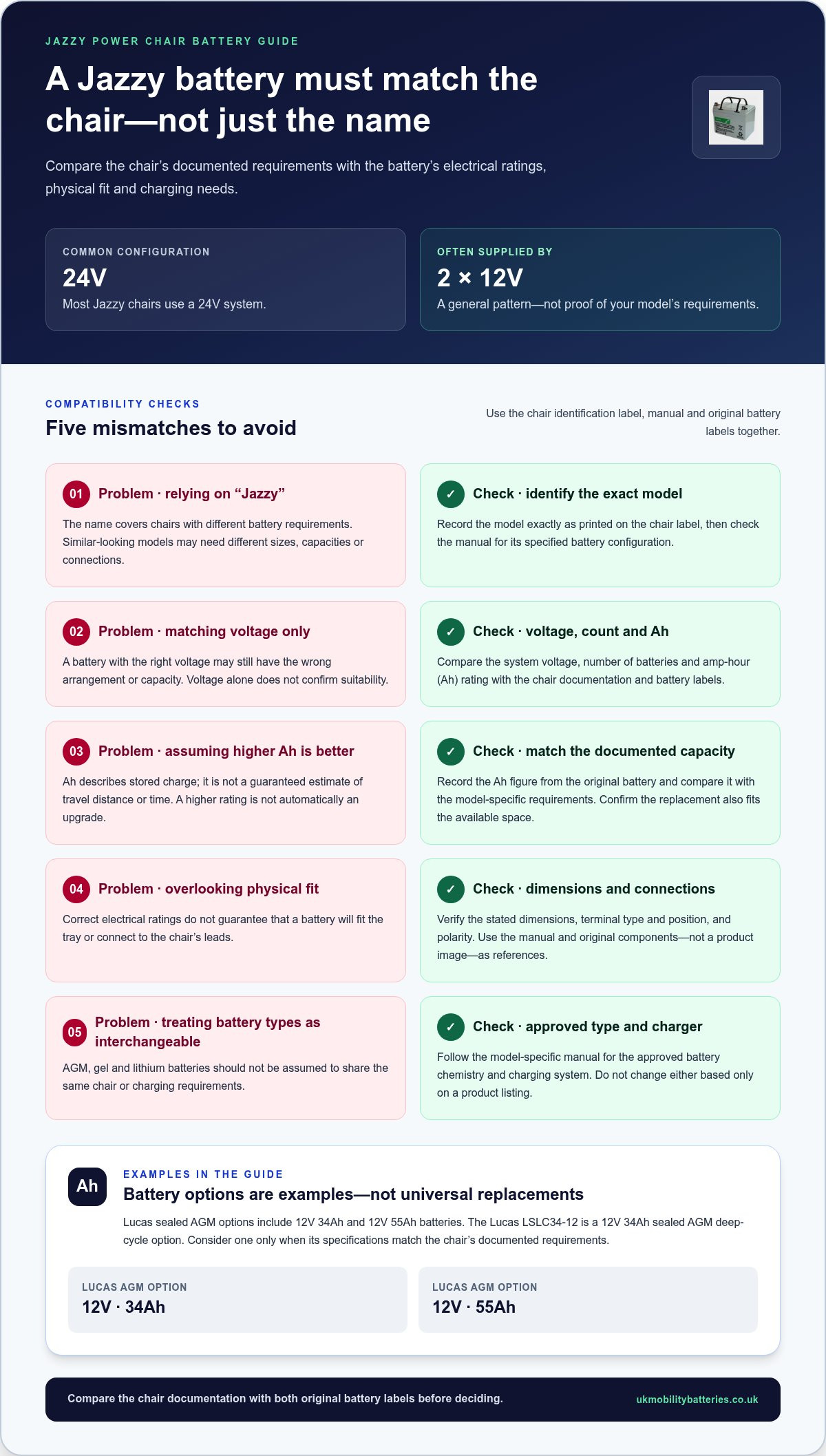
How to find and check a replacement battery for your Jazzy chair
A reliable search starts with the chair, not a product listing. Work through the checks in order, using the manual, chair label and battery label as reference points. Photograph the labels before searching, and record the ratings and codes in writing. Clear records make it easier to spot when a listing matches the complete specification or shares only one detail.
A practical five-step battery identification process
- Record the chair model. Read the identification label on the chair and compare it with the model name in the manual. Use the full designation, including any letters or numbers, rather than relying on the general Jazzy name.
- Document the existing batteries. Photograph each label and note the voltage, Ah capacity, visible product or model code, and number of batteries fitted. If a label is damaged or hard to read, record that rather than guessing the missing information.
- Check the physical arrangement. Use the original battery and chair documentation to compare dimensions, terminal type and position, and polarity. Record how the batteries sit in the tray and connect to the chair.
- Review chemistry and charging instructions. Check the manual for the specified battery type and charger requirements. Don’t assume a different chemistry is suitable just because the voltage or connector appears familiar.
- Confirm the complete match. Compare a candidate battery or pack with all the recorded requirements and the chair documentation. Treat it as a match only when the electrical, physical and charging specifications align.
How to assess a product listing before ordering
Read the full specification, not just the product title. Listings may highlight voltage or capacity while giving other fit details elsewhere in the product information. Compare each stated detail with your records, including dimensions, terminals, polarity, chemistry and the chair’s charging requirements. A shared voltage or Ah rating is a partial match, not proof that the battery is suitable.
Check the quantity supplied, too. A listing may describe one battery, while the chair’s documented arrangement calls for more than one. Confirm whether the product is sold individually or as a pack, and make sure the quantity corresponds with the chair’s requirements. Don’t transfer a match from another Jazzy model. Even a similar chair’s listing doesn’t establish compatibility with yours.
For removal or fitting, follow the instructions for your specific power chair first. The mobility battery changing guide offers related general guidance, but power-chair instructions take priority. If your recorded requirements are ready, compare replacement mobility batteries against them before choosing batteries for Jazzy power chair use.
Choosing a Jazzy power chair battery from UK Mobility Batteries
UK Mobility Batteries is a specialist retailer of mobility and wheelchair batteries, with sealed AGM options and technical support to help you compare product specifications. The right choice still depends on your chair’s documented requirements. A product’s voltage or battery category alone doesn’t establish that it will fit or operate correctly in a particular Jazzy model.
Which Lucas options may be worth comparing
The Lucas LSLC34-12 is a 12V 34Ah sealed AGM deep-cycle option. The 2 × Lucas LSLC55-12 12V 55Ah Sealed AGM Mobility Batteries are another option, supplied as a pair of sealed AGM mobility batteries for scooters, wheelchairs and backup systems. Compare either option with your chair’s manual and original battery details. Neither should be treated as a confirmed Jazzy fit without a documented model-specific match.
These examples show why capacity and battery count need to be considered together. A single battery and a pair are different purchase configurations, and a battery with a suitable-looking rating may still differ from the chair’s required dimensions, terminals, polarity or chemistry. The model name on a product listing isn’t a substitute for checking the full specification against the chair documentation.
What to have ready when selecting a replacement
Keep the exact chair model, photographs of the original battery labels and the relevant manual specifications together. Record the voltage, Ah rating, product code, number of batteries, dimensions and connection details where available. With this information to hand, UK Mobility Batteries’ technical support can help interpret battery information and compare product specifications without relying on a broad Jazzy category label.
Before deciding, compare each candidate against the points that determine compatibility:
- The chair’s specified battery type, voltage and battery arrangement.
- The original capacity rating and whether the listing is for one battery or a pair.
- Physical dimensions, terminal details and polarity.
- The chair’s charging instructions and any battery-type requirements.
Sealed AGM products use VRLA construction and are maintenance-free, spill-proof and leak-proof. Those characteristics help explain the product category, but they don’t confirm a match for your chair. Prioritise the documented requirements, and use retailer support to interpret the details where needed.
Once you’ve compared the complete specifications, browse mobility and wheelchair battery options from UK Mobility Batteries. Select batteries for Jazzy power chair use only when the option matches the chair’s documented requirements.
Make your next battery choice with confidence
Before choosing batteries for Jazzy power chair use, bring your chair and battery details together so you can compare replacement options against the requirements that matter. A careful specification match is a more dependable basis for choosing than a familiar model name or a single matching rating.
UK Mobility Batteries specialises in mobility scooter and wheelchair batteries, including Lucas sealed AGM options. Its technical support can help you interpret product specifications, and nationwide delivery is available. Use that support to make your comparison clearer, while keeping your chair’s documentation as the reference for compatibility.
When you’re ready, browse mobility and wheelchair batteries and assess the options against your recorded requirements. Start with your chair’s specifications and choose a replacement only when the details match.
Frequently Asked Questions
Can a Jazzy power chair battery be taken on an aeroplane?
It may be possible, but airline requirements depend on the battery type and the mobility device. IATA guidance distinguishes between lithium-ion, non-spillable batteries such as AGM or gel, and spillable wet-cell batteries. Contact your airline before travelling to confirm the rules for your specific battery and chair. Have the battery chemistry and its voltage and capacity details available when you make your enquiry.
Can a sealed AGM mobility battery be mounted on its side?
UK Mobility Batteries’ sealed AGM products are orientation-friendly and can be safely mounted in any position. Check the instructions for the exact battery, and make sure the chair’s battery tray and securing method suit that orientation.
Does a higher Ah battery always give a Jazzy chair more range?
No. A higher amp-hour rating indicates greater rated capacity, but it doesn’t guarantee a particular increase in range. Chair condition, load, terrain and usage can affect how far it travels. A higher-Ah replacement won’t help if the battery isn’t approved for the chair or the charger isn’t suitable. Check the model’s requirements before comparing capacity.
How long do batteries for a Jazzy power chair usually last?
Power-chair batteries typically last around one to two years with proper care, although actual service life varies with use, charging habits and storage conditions. A noticeable reduction in operating time may indicate that performance has declined, but it isn’t a precise lifespan test on its own. Keep a note of when the batteries were installed and follow the chair manufacturer’s charging and storage guidance.
What should I do with old wheelchair batteries?
Don’t put old wheelchair batteries in household rubbish or general recycling. They require an appropriate battery recycling route. Keep the battery intact and secure it against movement whilst arranging disposal; don’t attempt to open it. Recycling arrangements for larger mobility batteries can vary, so check your local council’s guidance for an accepted household waste or recycling centre, and follow its instructions for transporting the battery.
What does the one-year manufacturer guarantee cover?
The product information states a one-year manufacturer guarantee, but the exact cover depends on the terms for the specific battery. Use the product documentation to check which faults qualify, what evidence is needed and how to make a claim. Don’t assume the guarantee covers every cause of battery failure or associated costs unless the applicable terms explicitly say so.
Can I use my existing charger with a replacement battery?
Only if it’s suitable for the replacement battery type and the chair’s charging requirements. A charger used with an AGM battery, for example, shouldn’t automatically be assumed suitable for a lithium replacement. Check the chair manual and charger information before connecting a new battery. If the documented requirements don’t clearly match, don’t charge the replacement until the correct instructions have been established.