
Are Lithium Wheelchair Batteries Worth It? 2026 UK Guide
The battery with the longest lifespan isn’t automatically the best-value replacement. If you’re asking, “are lithium wheelchair batteries worth the cost?”, the answer depends on more than the purchase price. Your wheelchair’s battery requirements, charger compatibility and how often you use and recharge the chair all matter.
It’s sensible to weigh lithium’s higher initial cost against potential advantages such as a longer service life, faster charging and lower maintenance. Those benefits only count if the battery is compatible with your wheelchair and charging system. This guide compares lithium and AGM batteries in practical terms, explains what to check before choosing a replacement, and shows how to assess whole-life value using your own usage and replacement assumptions. It also explains when AGM may be a suitable option, so you can decide based on fit, everyday needs and long-term cost rather than chemistry alone.
Key Takeaways
- Whether lithium wheelchair batteries are worth the cost depends on compatibility, how you use your chair and how long you expect to keep the replacement.
- Compare lithium and AGM by practical factors such as weight, charging requirements and service life, not chemistry alone.
- Use your own figures to compare purchase cost, expected service period, replacement needs and any charger changes.
- Before choosing a battery, record its voltage, capacity, dimensions, terminals and arrangement, then check your wheelchair guidance and charger requirements.
- If AGM is the better fit, browse the retailer’s sealed mobility battery range for replacement options.
Are lithium wheelchair batteries worth the cost for everyday use?
Sometimes, but not for every wheelchair user. Whether lithium wheelchair batteries are worth the cost depends on compatibility, how often you use the chair, how long you expect to keep the battery and which benefits matter to you. A higher initial outlay may be offset by a longer service period or practical advantages, but those only count if the battery works with your wheelchair and charging system.
Compare lithium with AGM rather than assuming one chemistry is always better. Lithium-ion batteries store and release energy through lithium-ion movement within the cell; lithium-ion battery technology covers the underlying design and characteristics. AGM, or Absorbent Glass Mat, is a sealed lead-acid battery in which the electrolyte is held in a glass-fibre mat. The differences can affect use, but actual performance depends on the specific battery and chair.
What does “worth the cost” mean for a wheelchair battery?
Value means looking beyond the replacement battery’s purchase price. Include its expected service period, how often you may need another replacement, charging requirements and the cost of any equipment you’d need to change. These are the measurable parts of the comparison. Use figures that apply to the batteries and wheelchair you’re considering, rather than relying on a general claim that one chemistry always costs less over time.
There may also be practical benefits that don’t appear in a price calculation. Lithium batteries may weigh less than comparable AGM batteries, which could matter if handling the battery or the wheelchair’s overall weight is a concern. The difference and its usefulness depend on the specific battery, wheelchair design and user. Check the battery specifications and wheelchair guidance before treating lower weight as a deciding factor.
Who may benefit most from considering lithium?
Lithium may be worth investigating if you use your wheelchair frequently or place a high priority on reducing battery weight. Weigh those potential advantages against the replacement and charging requirements of the particular battery. A frequent user may value practical differences more than someone who uses their chair occasionally, but frequency of use alone doesn’t establish compatibility or prove better whole-life value.
If you use your chair occasionally, want a straightforward replacement or are familiar with AGM, an AGM battery may remain a sensible option. Don’t change chemistry solely to pursue a possible benefit. Start with the wheelchair manufacturer’s guidance, then compare compatible options against your expected use and replacement period. The right choice meets the chair’s requirements and delivers benefits you’ll actually use.
How lithium wheelchair batteries differ from AGM in use
Lithium-ion batteries and sealed AGM batteries store energy in different ways, so replacing one chemistry with another isn’t simply a matter of matching the label. Lithium-ion technology may offer a lower-weight battery for a given application, while AGM is a sealed lead-acid design used in mobility equipment. The actual weight, performance and charging requirements depend on the specific battery and wheelchair.
Battery chemistry affects compatibility as well as performance. Matching voltage or capacity alone doesn’t prove that a replacement will work with the wheelchair and its charger.
| Factor | Lithium-ion | Sealed AGM |
|---|---|---|
| Weight | May be lighter for a comparable application, but compare the specified battery weights and consider the chair’s design. | Weight varies by model and capacity; check the existing battery’s documentation. |
| Charging | Use only a charging arrangement specified as suitable for the battery. | Follow the AGM battery and wheelchair charging instructions; don’t assume a charger suits both chemistries. |
| Service life | Can offer a longer service life in some applications, but results depend on the battery, use and care. | Service life also varies with the battery and how it is used and charged. |
| Compatibility | Check wheelchair guidance, battery arrangement and charger requirements before considering a change. | Match the specified requirements and physical fit; the same checks still apply. |
Lithium wheelchair batteries: potential benefits and trade-offs
A lower battery weight may make handling easier or affect the overall wheelchair set-up, but the benefit depends on the actual weight difference and the chair’s design. Lithium batteries may also have different energy density and service-life characteristics from AGM. These aren’t guaranteed outcomes: compare the specifications and manufacturer guidance for the exact battery and wheelchair instead of relying on general chemistry claims.
Charging is another compatibility check. Don’t assume that a charger used with an AGM battery is suitable for a lithium replacement. Follow the instructions for the wheelchair, battery and charger as a set. If you travel by air, requirements are a separate consideration: the FAA guidance on flying with wheelchair batteries applies to US aviation, so it shouldn’t be treated as UK airline guidance.
AGM wheelchair batteries: where they remain a practical option
Sealed AGM remains a familiar mobility battery option for like-for-like replacement, provided the battery matches the wheelchair’s requirements. It isn’t automatically the right choice for every user, just as lithium isn’t automatically an upgrade. UK Mobility Batteries offers sealed AGM mobility battery options, including Lucas batteries. Explore the sealed AGM mobility battery range if AGM suits your requirements.
Lithium vs AGM wheelchair batteries: compare lifetime value, not just price
The lowest purchase price is not always the lowest lifetime cost. To compare lithium and AGM fairly, choose the same ownership period for both options and use figures that apply to the batteries and wheelchair you’re considering. Include any required charger or other equipment changes, but don’t assume a chemistry change will work with your existing set-up.
Use this fill-in comparison. Enter your own figures in pounds and base expected service periods on relevant battery documentation, not a generic lifespan promise.
- Comparison period: ____ years
- Lithium purchase price: £____; expected service period: ____; replacements during the comparison period: ____
- AGM purchase price: £____; expected service period: ____; replacements during the comparison period: ____
- Required charger or equipment costs: lithium £____; AGM £____
A simple wheelchair battery ownership-cost calculation
For each option, calculate: initial battery purchase + required equipment costs + the cost of any replacement batteries needed during your chosen period. Use the same period for both options. Count the initial battery separately from later replacements, and use the purchase figures available to you rather than general market estimates.
Don’t force a break-even result if the inputs are uncertain. Battery life varies by product and use, so treat service-period figures as estimates and consider how the result changes if a battery lasts for less time than expected. You can find further context in an electric wheelchair battery life expectancy guide.
Keep charging costs separate unless you have dependable information about your charging routine and electricity tariff. Without those inputs, a precise saving would be guesswork. Include a charger change as a cost only if the selected battery and wheelchair requirements make it necessary.
Which benefits have financial value, and which are personal?
Not every useful difference has a reliable monetary value. A lighter battery may be easier for someone to handle, but the benefit depends on the battery’s actual weight and the user’s needs. Record it as a practical preference unless you can identify a specific, measurable saving.
Consider how often you use the wheelchair, how charging fits into your routine and whether replacing the battery during your chosen period would be disruptive. These priorities can affect which option feels worthwhile even when the calculated totals are close. If you’re asking, “are lithium wheelchair batteries worth the cost?”, compare your figures alongside the benefits you’ll genuinely use, then base your decision on compatible options rather than the lowest initial price alone.
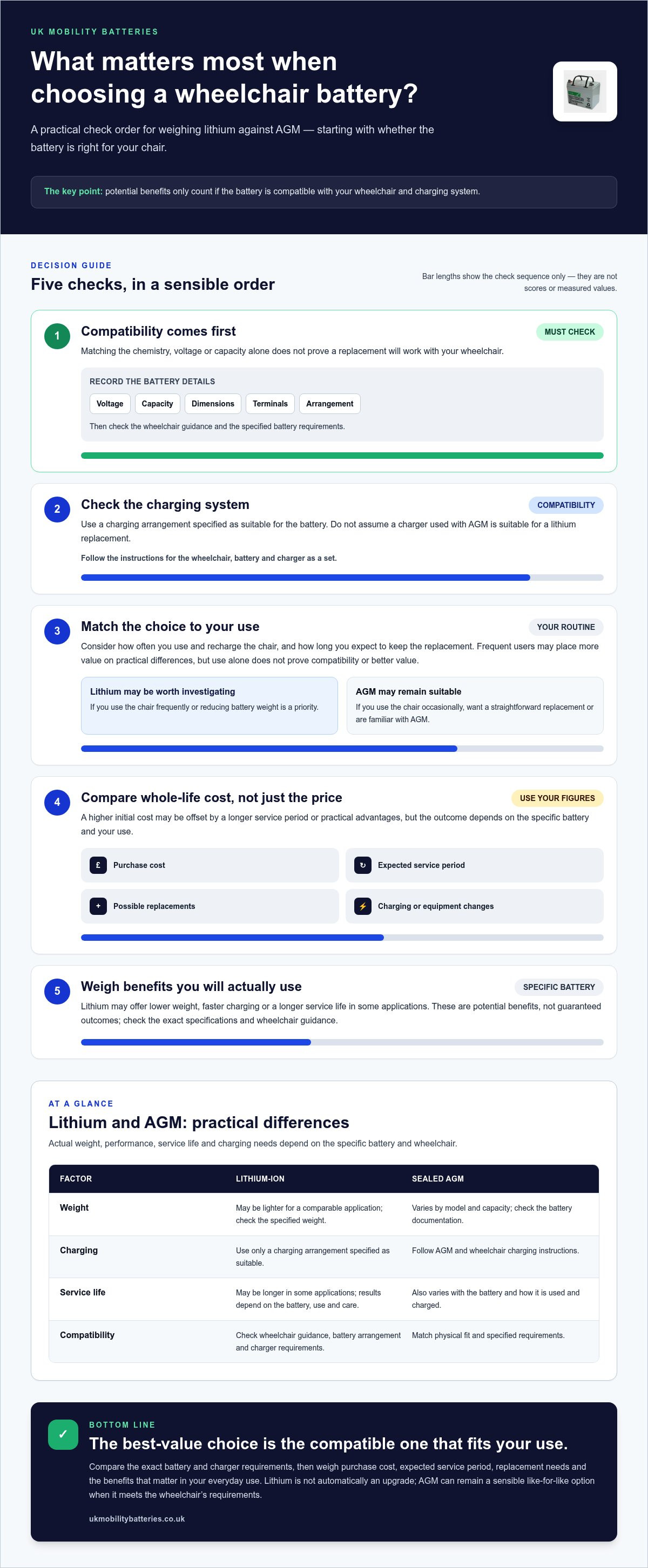
Use this checklist to decide whether lithium suits your wheelchair
Check technical suitability before comparing price or everyday benefits. A battery that fits physically may still be unsuitable if its chemistry, charger or electrical arrangement doesn’t match the wheelchair’s requirements. Work through these steps using the chair’s manual and existing battery documentation.
- Identify the current battery. Record its voltage, capacity, dimensions, terminal type and arrangement. If the wheelchair uses more than one battery, note how they are connected, such as in series or parallel.
- Check the wheelchair guidance. Find the manufacturer’s permitted battery chemistry and specifications. Don’t assume lithium can replace AGM, even if the voltage and capacity appear similar.
- Confirm charger compatibility. Check the wheelchair, battery and charger instructions together. Reuse an existing charger only if the documentation confirms it’s suitable for the replacement chemistry and battery.
- Compare value for your use. Consider your charging routine, expected replacement period, any required equipment changes and whether reducing battery weight would make a practical difference to you.
Check wheelchair, battery and charger compatibility first
Use the wheelchair manual or manufacturer specifications to establish what the chair supports. Compare the documented voltage, capacity, dimensions and terminals, then check the battery arrangement. If batteries are connected in series or parallel, replace them in a way that follows the wheelchair’s instructions. Chemistry matters too: the correct charger and any battery-management requirements depend on the specified system.
If the documentation doesn’t clearly establish that a lithium replacement and charger are suitable, don’t infer compatibility from matching voltage alone. Follow the manufacturer’s instructions before changing chemistry.
Match battery choice to real use
Write down how often and how far you typically use the wheelchair, how charging fits into your routine, and whether the chair is stored for extended periods. Then separate requirements from preferences: the manufacturer’s specifications are requirements, whilst lower weight or a particular charging routine may be personal priorities.
Use your expected service period and replacement assumptions to compare whole-life cost, and weigh any handling benefit against the initial outlay. If the existing battery appears to be failing, review mobility scooter battery troubleshooting before treating a chemistry change as the solution. Symptoms alone don’t establish which replacement type is suitable.
Once you’ve recorded the specifications, use them to narrow down compatible options. If AGM meets the wheelchair’s requirements, browse sealed AGM mobility batteries as a replacement category.
Choose a compatible wheelchair battery and plan your next step
The decision comes down to two tests: does the battery meet your wheelchair’s documented requirements, and do its practical benefits justify the whole-life cost for your use? Lithium may suit your priorities when compatibility is established and benefits such as lower weight matter to you. If it doesn’t meet the chair’s specifications, or the extra benefits aren’t useful in your routine, an AGM replacement may be more appropriate.
What to confirm before ordering a replacement
Before choosing a battery, compare the existing set-up with the wheelchair documentation. Check the required voltage and capacity, then confirm the dimensions and terminal type so the replacement fits and connects correctly. Record how many batteries the chair uses and whether they are connected in series or parallel. Finally, check the specified battery chemistry and charger requirements. Don’t assume a battery is interchangeable because one or two figures match.
Keep these details together when comparing replacement options:
- Voltage and capacity
- Battery dimensions and terminal type
- Number of batteries and connection arrangement
- Permitted battery chemistry and charger requirements
Use the wheelchair manufacturer’s guidance as the reference for technical requirements. If considering a different chemistry, check that the battery and charging arrangement are explicitly suitable for the chair.
Browse mobility batteries with the right specifications
Once you have the required specifications, use them to narrow down replacement choices rather than browsing by battery type alone. For wheelchairs that call for AGM, UK Mobility Batteries offers sealed AGM mobility battery options, including Lucas batteries. Expert technical support can help you understand battery specifications as you compare suitable options.
Verify wheelchair requirements before comparing replacement battery technologies. If your documented requirements point to AGM, you can browse sealed AGM mobility batteries at your own pace. The question, “are lithium wheelchair batteries worth the cost?”, has a practical answer: consider lithium only when it meets the wheelchair’s requirements and the benefits you expect justify its total ownership cost.
Choose your next wheelchair battery with confidence
Are lithium wheelchair batteries worth the cost? They can be, if the battery is compatible with your wheelchair and its longer-term benefits matter in your everyday routine. Compare the total ownership cost, including any required charger changes and replacements, rather than judging by the initial outlay alone. If AGM better matches your requirements and priorities, it remains a practical replacement option.
Before selecting a battery, use your wheelchair documentation to check the required chemistry, voltage, capacity, dimensions, terminals and battery arrangement. These details help narrow the options and reduce the risk of choosing a battery that won’t suit the chair.
UK Mobility Batteries offers a specialist range of sealed AGM mobility batteries from 7Ah to 150Ah, with expert technical support and delivery across the UK. Use your recorded specifications to browse mobility batteries and choose a replacement that matches your requirements.
A clear compatibility check and an honest comparison of your needs make the next step simpler. Choose the battery that fits your wheelchair and supports the way you use it.
Frequently Asked Questions
Are lithium wheelchair batteries worth the higher upfront cost?
Sometimes, but only if the battery is compatible and its benefits justify the full ownership cost. Whether lithium wheelchair batteries are worth the cost depends on how often you use the chair, how many replacements you expect over your chosen period, and whether lower weight or other practical gains matter to you. Compare documented costs and lifespan information for specific batteries, not broad claims. AGM remains practical if it meets requirements and suits your priorities.
Can I replace my wheelchair’s AGM battery with a lithium battery?
No. Replacing an AGM battery with lithium isn’t automatically a like-for-like swap. Check the wheelchair’s permitted battery chemistry and required voltage, capacity, physical dimensions and connections. Battery-management and charger requirements must also meet the battery and wheelchair manufacturers’ instructions. Use the wheelchair manual or manufacturer specifications to establish what’s suitable. If lithium compatibility isn’t specified, don’t fit it based only on matching voltage or capacity.
How long do lithium wheelchair batteries last compared with AGM batteries?
There’s no single lifespan that applies to every lithium or AGM wheelchair battery. Actual service life depends on battery design, charging practices, operating conditions and how the wheelchair is used. Check manufacturer-published information for the exact batteries you’re comparing, including any conditions attached to lifespan estimates. For a fair cost comparison, use consistent assumptions about replacement frequency and the same ownership period for both chemistries.
Do lithium wheelchair batteries need a different charger?
Not necessarily, but charger suitability depends on the battery chemistry and the battery manufacturer’s requirements. Don’t assume an existing AGM charger is suitable after changing to lithium, even if the connector fits. Check the wheelchair and battery documentation for approved charging equipment, voltage and charging specifications before using or buying a charger. Use only a charger documented as compatible with the complete set-up.
Are lithium wheelchair batteries lighter than AGM batteries?
Lithium batteries can be lighter than AGM options, but the difference depends on the specific battery’s capacity and design. Compare weights for compatible battery set-ups, including every battery the wheelchair requires, rather than relying on chemistry labels alone. Reduced weight matters most when it solves a real handling issue or supports how you use the chair. Check published specifications for the exact models before treating weight as a deciding advantage.
How do I work out whether lithium will save money over time?
Compare the total cost for both battery types over the same ownership period. Include each initial purchase, any required compatible charger or equipment, and likely replacement purchases based on manufacturer lifespan information. Keep charging savings separate unless you have reliable usage data and your electricity tariff. The outcome depends on actual wheelchair use, service life and replacement assumptions. Record personal benefits, such as easier handling, separately from measurable financial savings.
Is lithium safe to use in an electric wheelchair?
Safety depends on using a battery system, charger and installation that meet the wheelchair manufacturer’s instructions. No chemistry should be treated as automatically safe or unsafe in every set-up. Use compatible equipment and follow the manual for charging and handling. If a battery is damaged or behaves abnormally, stop using it and follow the manufacturer’s safety guidance. Don’t attempt an unapproved chemistry change.