
12v 22ah sealed lead acid battery charging and capacity
A 22Ah rating describes the battery’s nominal capacity, not the energy it will deliver in every application. A 12V 22Ah sealed lead-acid battery is rated at 22 amp-hours, while its usable output depends on the discharge conditions and the battery’s specification. The correct charging current also depends on the manufacturer’s limits, so a charger should match the battery type and rating.
Choosing by voltage and amp-hours alone can leave important details unanswered. This guide explains how to interpret capacity, what to look for in charging guidance, and why dimensions and weight matter when fitting a replacement. It also compares AGM and deep-cycle descriptions, helping you distinguish the battery’s construction from its intended use. You’ll have a practical framework for comparing specifications and deciding which details matter for your equipment.
Key Takeaways
- Compare a replacement battery’s full dimensions and terminal layout with the available space and connections in your equipment.
- Use charging guidance suited to the battery’s construction, and consider how discharge conditions affect the capacity available in practice.
- Distinguish AGM construction from deep-cycle use: the terms describe different specification points, so read them together when comparing batteries.
- Match voltage, capacity and intended application to your equipment before choosing from the available mobility battery options.
Battery dimensions and weight
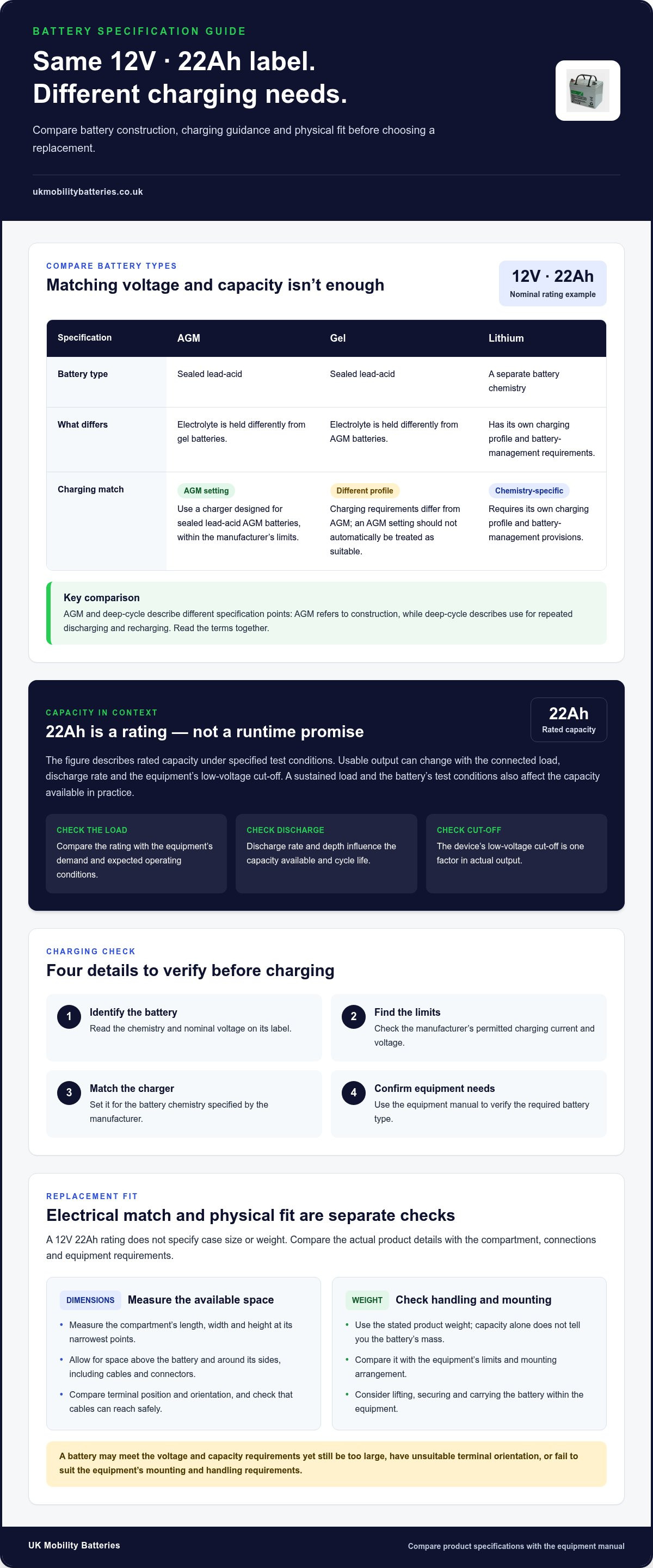
A 12V 22Ah rating describes electrical capacity, not a fixed case size. Compare the physical specification and terminal arrangement before choosing a replacement.
Battery dimensions
Measure the battery compartment’s length, width and height, then compare those measurements with the replacement’s listed dimensions. The 12V 22Ah capacity alone cannot establish whether its case will fit. Check for space above the battery and around its sides, including room for cables and connectors.
Check terminal position and orientation as well. A battery may fit the compartment but still be unsuitable if the terminals face the wrong way or the cables cannot reach safely. Before removing the existing battery, note its layout and compare it with the replacement’s specifications.
Battery weight
Weight matters when a battery must be lifted, secured or carried within equipment. A 12V 22Ah rating does not specify mass, because case design and internal construction affect the finished battery’s weight. Use the stated product weight when planning a replacement or handling it during installation.
Consider the equipment and the person lifting the battery. It must sit securely in the compartment without shifting during use. Compare the replacement’s weight with the equipment’s limits and mounting arrangement, rather than using capacity as a guide to physical fit.
Use this simple comparison process for a replacement:
- Measure the existing battery compartment at its narrowest points.
- Note the battery’s terminal layout and cable reach.
- Compare the replacement’s length, width and height against available space.
- Check the stated weight against the equipment’s mounting and handling requirements.
These checks distinguish electrical suitability from physical fit. A battery can match the required voltage and capacity but still be too large for the cover to close. Likewise, a terminal mismatch can prevent a secure connection, even when the case dimensions appear suitable.
Keep the equipment model and existing battery label together while comparing specifications. That makes it easier to assess case size, weight and connections as separate requirements. Confirm each point against the actual product data, rather than estimating from the 12V 22Ah label.
Charging current and capacity
A 12V 22Ah AGM battery and a 12V 22Ah gel battery share nominal voltage and capacity. Their charging profiles differ, while a lithium alternative uses different charging requirements and battery chemistry.
The 22Ah figure describes rated capacity under specified test conditions. It isn’t a promise of identical runtime in every device. Actual output changes with the connected load, discharge rate and equipment’s low-voltage cut-off. A mobility scooter drawing more current can use capacity differently from a lower-demand device. Compare the battery rating with the equipment specification and expected operating conditions.
Charging current must stay within the battery’s limits. Check its label or manufacturer’s instructions for the permitted current and charging voltage, and use a charger designed for sealed lead-acid AGM batteries. A charger for gel or lithium batteries may use a different charging profile. Matching the charger to the battery helps avoid unsuitable charging conditions.
For a practical check, follow these steps:
- Identify the battery chemistry and nominal voltage on its label.
- Find the manufacturer’s charging-current and voltage limits.
- Match the charger’s battery setting to the stated chemistry.
- Use the equipment manual to confirm the required battery type.
AGM and gel batteries are both sealed lead-acid types, but their internal electrolyte is held differently. That distinction affects their charging requirements, so an AGM charger setting shouldn’t automatically be treated as suitable for gel. Lithium batteries are a separate chemistry, with their own charging profile and battery-management requirements. Equal 12V and 22Ah labels don’t make these types interchangeable.
Capacity also needs context. For example, a battery rated at 22Ah may not provide the full rated capacity under every discharge pattern. A sustained load, the device’s cut-off setting and the battery’s test conditions all influence usable output. Read the capacity alongside the manufacturer’s test basis, then compare it with the equipment’s requirements. This gives a more useful assessment than treating amp-hours as a guaranteed runtime figure.
Deep-cycle sealed lead-acid battery
Deep-cycle batteries are designed for repeated discharging and recharging. Their cycle life depends on how they are used and charged.
Cycle life and depth of discharge
Depth of discharge is the proportion of a battery’s stored capacity that is used. Deeper discharges place greater demands on its cells, and repeated discharge patterns affect cycle life, or the number of charge-and-discharge cycles it completes. Compare the manufacturer’s cycle-life information at the stated discharge depth, then consider whether it suits the equipment’s typical use.
For example, a device that regularly draws power for longer periods may discharge its battery further between charges. The battery’s charging method and operating conditions also influence its service life. Follow the battery and equipment instructions, and avoid treating the 22Ah label as a cycle-life rating.
Devices and applications
A 12V 22Ah sealed lead-acid battery can power equipment designed for that voltage, capacity and battery type. Mobility scooters and wheelchairs are examples where the equipment manufacturer specifies a compatible battery. Check the manual and existing battery label before selecting a replacement. Capacity alone doesn’t establish compatibility.
Deep-cycle batteries suit equipment that draws power repeatedly before recharging. Whether this design is appropriate depends on the load and operating pattern. A standby system, for example, may have different demands from equipment used throughout the day.
Before storing or transporting a battery, switch off the equipment and follow its battery instructions. Protect the case, secure the battery against movement, and keep the terminals away from metal objects. Store it away from damage and heat sources.
In the UK, recycle the battery through a collection route that accepts lead-acid batteries, such as a suitable local recycling centre. Keep it out of household waste and protect the terminals during transport to prevent damage and support appropriate handling.
AGM sealed lead-acid battery specifications
AGM describes how electrolyte is held within a sealed lead-acid battery. The glass mat separates and absorbs electrolyte between the lead plates. For a 12V 22Ah model, voltage and capacity are only part of its specification. Construction, charging requirements, case dimensions and terminal format also matter.
Start with the equipment manual. Match its required voltage, battery chemistry and connection arrangement. Then compare the battery label with the charger settings. A charger intended for another chemistry may use a different charging profile, even if its voltage appears suitable. The 12V 22Ah rating doesn’t establish charging current or terminal compatibility.
12V 22Ah SLA batteries can use different terminal formats and sizes. Common formats include flat blade terminals and threaded connections, but the battery’s actual terminal details determine fit. Compare the existing battery’s terminals, cable connectors and polarity before selecting a replacement.
Inspect these specification points together:
- Voltage and capacity: confirm the equipment’s stated requirements.
- Battery construction: distinguish AGM from gel or lithium chemistry.
- Charging data: follow the manufacturer’s voltage and current limits.
- Case and terminals: compare physical fit, connector type and polarity.
For example, an AGM battery may match a device’s 12V requirement but have terminals that don’t accept its existing connectors. A physically compatible case also won’t establish that its charging profile suits the equipment. Treat each specification as a separate compatibility check, rather than relying on the 22Ah figure alone.
Record the battery label and equipment model before comparing options. This makes it easier to identify which requirements must match and which details relate only to physical fit. The Lucas 12V 34Ah Sealed AGM Deep Cycle Battery is a different-capacity option, not a direct substitute for every 22Ah battery. Compare its rating with the equipment’s stated needs.
For mobility equipment, explore sealed AGM battery options after identifying the required voltage, capacity and terminal arrangement.
UK Mobility Batteries: Lucas 12V 7Ah Sealed AGM Batteries
UK Mobility Batteries offers Lucas 12V 7Ah Sealed AGM Batteries for equipment specified for that voltage and capacity. Choose a battery by matching its rating and construction to your equipment, rather than treating a 7Ah model as a replacement for a 22Ah battery.
Other options include the Lucas 12V 9Ah Uprated Sealed AGM Battery, Lucas 12V 20Ah Mobility Battery and Lucas 12V 34Ah Sealed AGM Deep Cycle Battery. These have different capacities and specifications, so compare the equipment requirements, terminal arrangement and physical fit before selecting one. The 34Ah model is identified as deep cycle, which may suit equipment designed for that battery type.
If you’re comparing mobility battery options, contact UK Mobility Batteries to discuss your requirements.
Make the next battery choice with confidence
Treat a replacement as part of equipment planning, not an isolated purchase. Consider whether the equipment’s current operating pattern still suits the battery specification. If its use has changed, the previous choice may no longer meet its demands. Resolve this before arranging a replacement.
For a 12V 22Ah sealed lead-acid battery, keep the decision tied to the equipment’s requirements rather than choosing by capacity alone. A carefully matched battery and charging setup support consistent operation. If you’re considering a different battery type or capacity, treat that as a change to the equipment setup, not simply a like-for-like swap.
UK Mobility Batteries offers mobility battery options for different equipment requirements. Contact UK Mobility Batteries to discuss your next battery choice. A clear decision now can make the next replacement process more straightforward.
Frequently Asked Questions
What are the dimensions and weight of a 12V 22Ah sealed lead acid battery?
There isn’t one fixed size or weight for every 12V 22Ah sealed lead-acid battery. These measurements depend on the model’s case and construction. Before ordering, compare the exact product specifications with the battery compartment, including clearance for cables and the cover. For example, two batteries with the same voltage and capacity may still differ physically, so the rating alone can’t establish fit.
How long will a 12V 22Ah battery run a given load?
Runtime depends on the load and the capacity available under those operating conditions. As a starting estimate, divide usable amp-hours by the load in amps. This gives an approximate runtime, not a guaranteed one. A mobility scooter draws different amounts of power when accelerating, travelling or climbing, and equipment cut-off settings also affect how long it runs.
How do you charge and maintain a 12V 22Ah sealed lead acid battery?
Charge the battery with a charger suitable for its sealed lead-acid type, following the battery and charger instructions. If it is an AGM battery, select the correct AGM setting and let the charger complete its cycle as directed. For routine care, keep the case clean and check for visible damage or loose connections. Don’t open or modify the sealed case; follow the manufacturer’s storage and maintenance guidance.